



Disclaimer: We own positions in both companies. This is intened for educational purpose. This is not financial advice thus do your own research.
Every investor loves company with a moat until one is actually tested with supply chain constrains. It's easy to call a company defensible when the cycle is calm and competitors are quiet. The real test is what happens when demand goes vertical, customers have nowhere else to go, and the company holding the chokepoint has to decide how hard to press its advantage.
That test is happening right now, in real time, at ASML and TSMC.
Every hyperscaler, earnings call promises more compute. Every chip launch promises more performance. However, the two companies standing at the literal physical chokepoint of this entire industry are: the only lithography maker capable of printing leading-edge chips, and the only foundry that can run those machines at hyperscaler scale are telling anyone who will listen that they cannot make enough, fast enough, for years to come.
That’s not a company under siege. That’s a moat doing exactly what a moat is supposed to do.
When Christophe Fouquet, ASML's CEO, says "demand for chips is outpacing supply," and when TSMC's C.C. Wei tells shareholders the chip shortage will last "for years," neither is apologizing. They're describing a market structure that has handed two companies extraordinary pricing leverage over the most important capital cycle of this decade and, notably, both are choosing restraint over maximum extraction, which is itself a sign of how secure that position really is.
This piece breaks down both businesses, what their latest numbers say about the strength of their respective moats, why their CEOs are drawing such a sharp line around the word "bottleneck" even as they hold all the leverage, and what it means for how you should be thinking about positioning in this sector.
Chapter 1: Two moats standing at the choke point
ASML — the company that makes the machines that make the chips
We provided a deep business dive in our article below:

Simply put it ASML has monoploy on extreme ultraviolet (EUV) lithography systems fire a laser at tin droplets 50,000 times per second to generate plasma that emits 13.5-nanometer wavelength light. EUV is used to etch nano features producing leading-edge AI chips at TSMC, Samsung, and Intel.
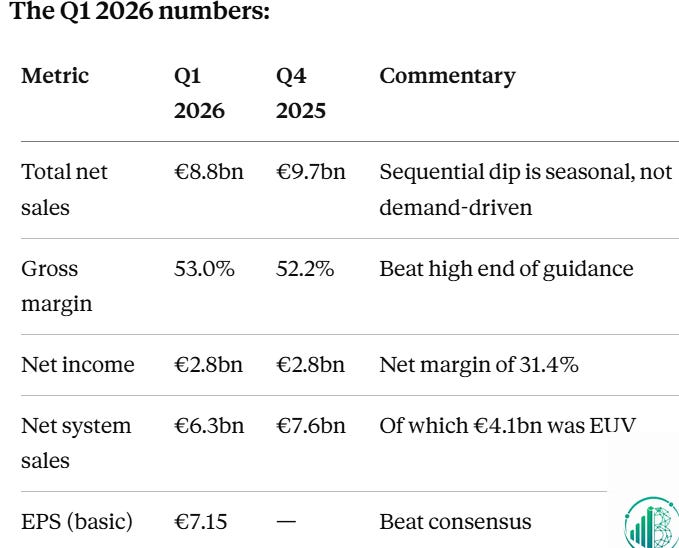
ASML reported its full 2025 results, 2025 total net sales came in at €32.7 billion with a gross margin of 52.8% and net income of €9.7 billion. The fact that ASML raised the bottom of its own range by €2.8 billion (31.4%) after just one quarter tells you the order book is moving faster than even ASML expected. Q4 2025, quarterly net bookings came in at €13.2 billion, of which €7.4 billion was EUV that backlog is what's giving ASML the confidence to keep raising guidance even as quarterly shipments.
The capacity commitment of ASML according to CFO Roger Dassen states that the company should be able to ship 60 of its bestselling low-NA EUV tools in 2026, 25% more than in 2025, and will have capacity to ship 80 in 2027. This provides a positive of outlook for investors in upcoming quarters.
TSMC: the foundry through which the entire AI stack runs.
ASML makes the lithography machines, TSMC is the company that uses these machines to fabricate the chips that are essential for major AI accelerator desinger such as Nvidia, AMD, Apple Google, Amazon, Broadcom. None of whom own their own leading-edge fabs, hence fabless.
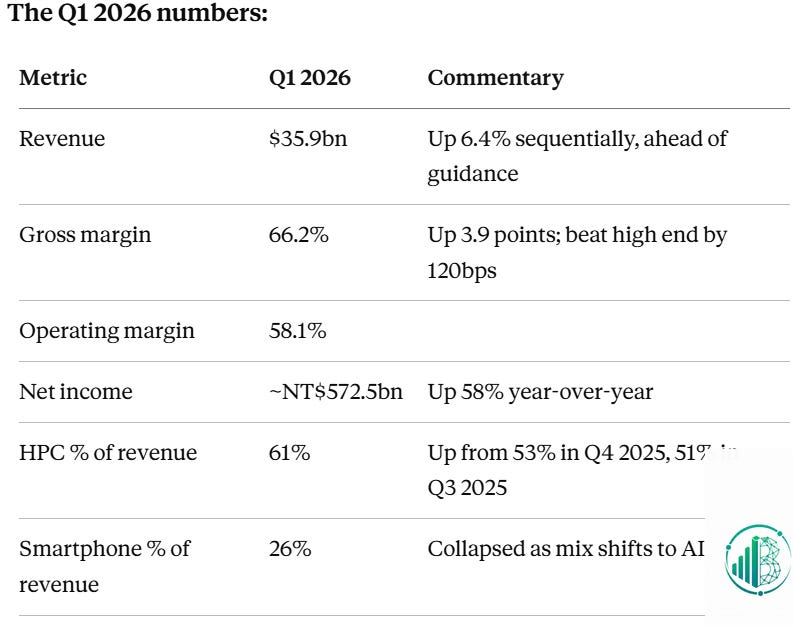
TSMC reported first-quarter 2026 revenue of $35.9 billion, up 6.4% sequentially and slightly ahead of guidance, with gross margin expanding 3.9 percentage points to 66.2%, exceeding the high end of prior guidance by 120 basis points, while operating margin rose to 58.1%. The mix shift is the real story here: HPC hit 61% of revenue in Q1 2026, up from 53% in Q4 2025 and 51% in Q3 2025, while smartphones collapsed to 26% of the mix. The HPC (AI/data center) slice growing by roughly 5 points a quarter while the smartphone slice shrinks at almost the same rate. This shows that TSMC leads the market; it's TSMC's existing capacity being systematically reallocated toward the highest-margin i .e. HPC, which is the highest-demand customer base TSMC has ever had.
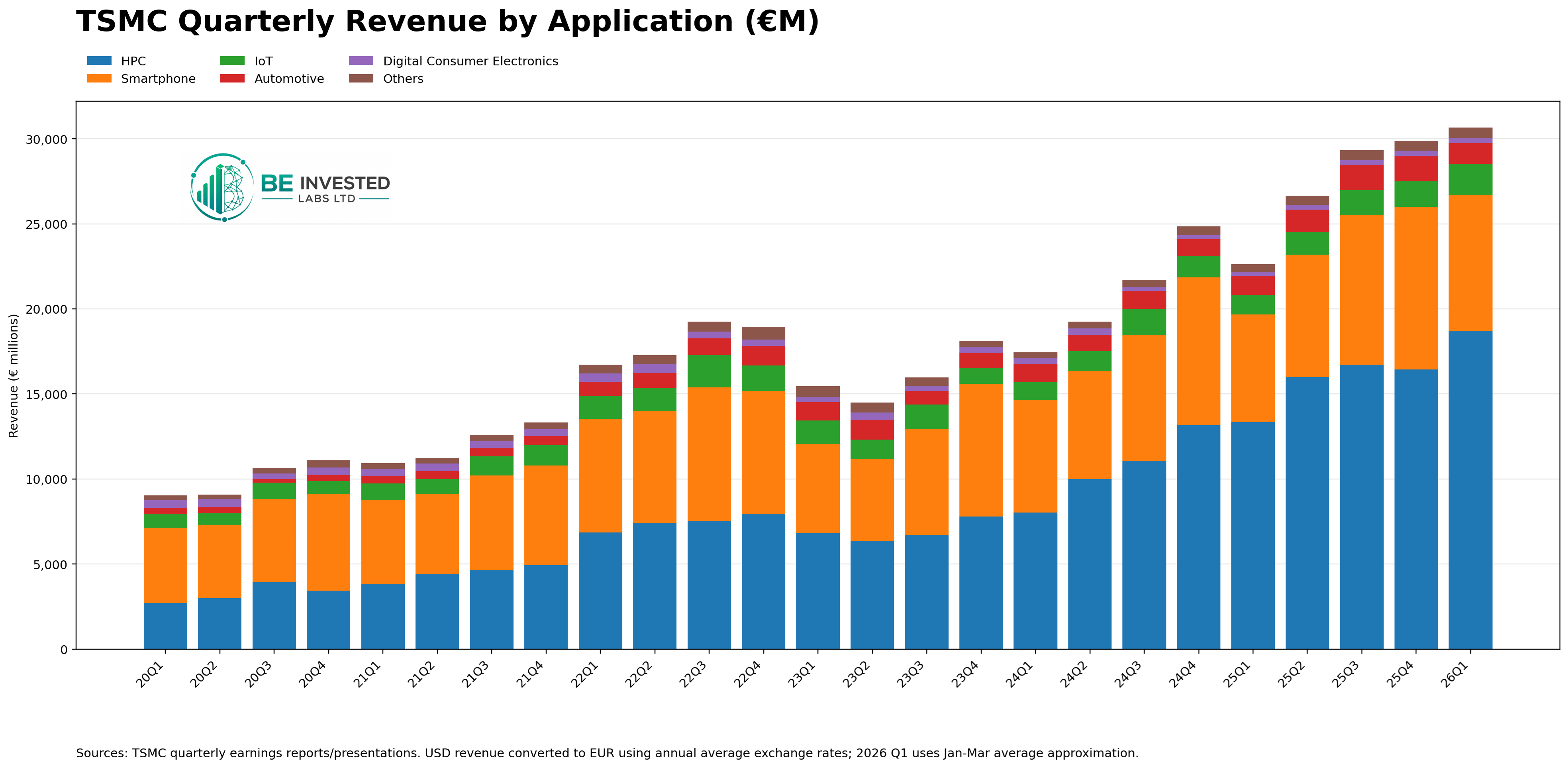
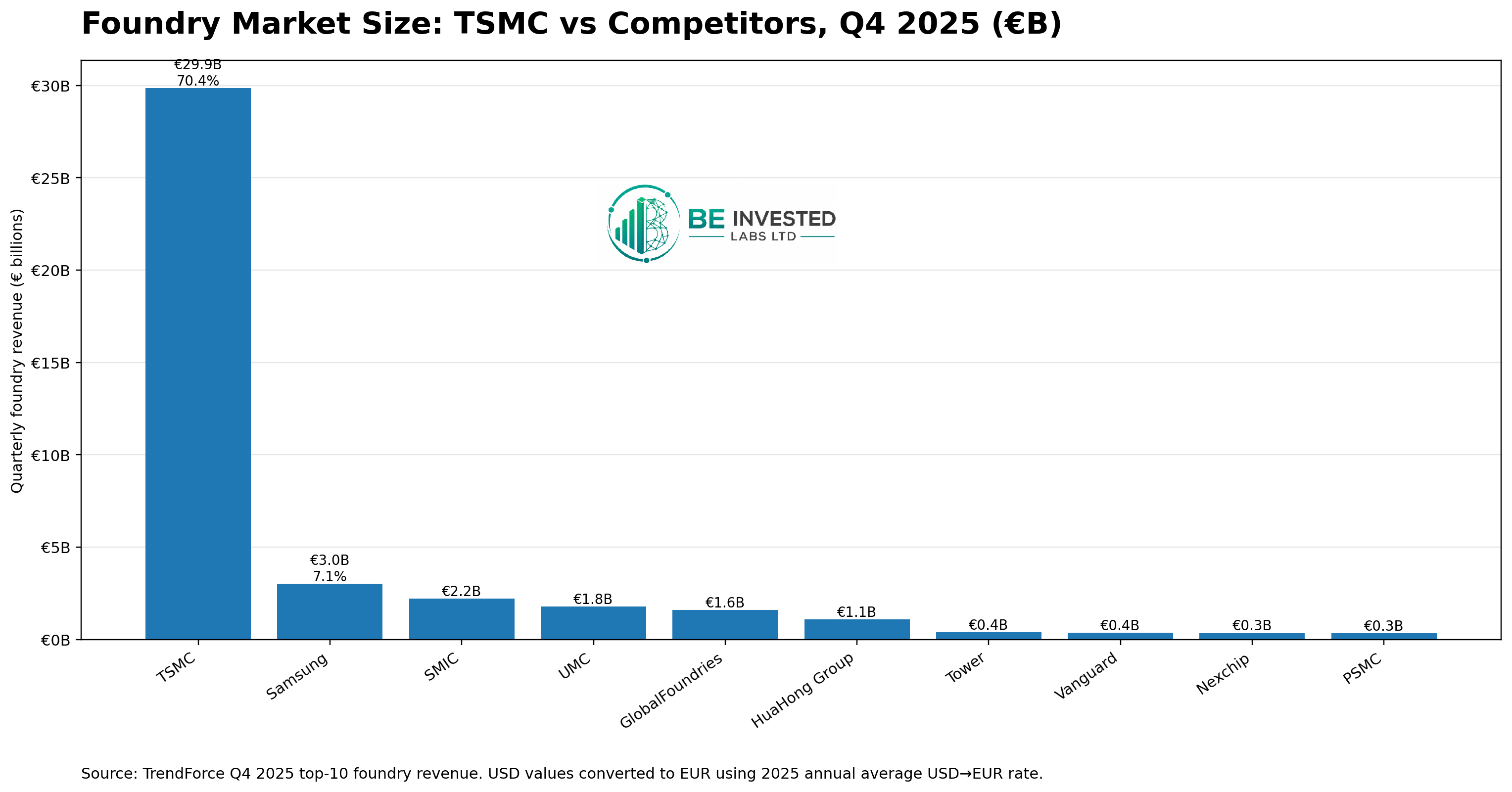
Guidance from TSMC management shows an increase in outlook of production. Management raised the full-year 2026 revenue guide from "mid-20% year to year" to "above 30% year to year", and capex guidance for the full year sits at $52-56 billion, targeting the high-end for capacity expansion in Fab in Arizona, Japan and Germany. For context on how fast that capital intensity is accelerating: that $52-56 billion is up roughly 30% from the $40.9 billion invested in 2025, setting a new historical record.
TSMC chokehold on the market: TSMC’s (CoWoS) Chip-on-Wafer-on-Substrate for advanced packaging which is the process that physically bonds high-bandwidth memory (HBM) on GPU die. This has become arguably challenging than etching the leading-edge logic wafers themselves. TSMC’s capacity for CoWoS is sold out until 2027 for new customers. This single handedly reveals that even if TSMC could magically produce more raw silicon, it can't ship a finished AI chip without packaging capacity it has already fully allocated for the next two years.
Chapter 2: The clearest proof of the moat from both CEOs.
The following are details that should make any investor sit up and pay attention. Both companies are sold out years in advance. Both could, in theory, raise prices aggressively and let customers fight over scraps like how makers of memory like Micron increased prices. Instead, both CEOs are spending unusual amounts of public energy insisting they are not the constraint, and pointing calmly, specifically at other parts of the chain instead. That's not modesty. Only a company with no real competitive threat to its own position has the luxury of redirecting blame elsewhere rather than defending its turf.
ASML CEO Fouquet framed it as “the biggest bottleneck seems to be in chip manufacturing”. Fouquet’s message is clear: the AI boom is pushing the semiconductor industry into a prolonged supply-constrained phase. At a tech event in Antwerp, Fouquet state that "Demand on AI is coming so strongly that we will be in a supply-limited market for quite a while,"
ASML is still under pressure, however, because its ability to support customers depends on scaling its own supply chain, capacity, and execution speed. In practical terms, ASML is saying: fabs may be the immediate constraint, but we cannot allow lithography equipment availability to become the next limiting factor. This framing also explains Fouquet’s comments on projects such as Musk’s proposed “Terafab”: massive new AI-driven fab capacity is an opportunity for ASML, he stated, “New projects are an opportunity as long as you're not supply limited”
That's a CEO explicitly naming the risk that his own company could become the reason a customer's mega-project stalls and committing, publicly, to not let that happen. It's a confident or positive posture: only the company holding the only machine of its kind can credibly promise a customer like Musk that it won't be the reason the project slips.
TSMC’s Wei framed it as “we are doing our best to ensure TSMC does not become a bottleneck“.
This reveals that TSMC is under extreme AI-driven demand pressure, but it is working to ensure it does not become the next structural bottleneck in the semiconductor supply chain. The important nuance is pricing discipline: unlike memory makers (such as (Samsung, SK Hynix, Micron) that allowed HBM scarcity to trigger sharp, commodity-like price spikes, TSMC is signaling controlled and predictable price increases. Wei pushed back against the kind of abrupt pricing moves seen in memory chips, signaling instead measured, predictable increases that fund TSMC's capex without damaging long-term customer relationships.
What this restraint actually reveals about the moat
Read together, both above statements are doing the same strategic job: each company is secure enough in its position that it can spend its leverage on reputation and customer trust instead of squeezing every available dollar out of the shortage. That’s a luxury weaker competitors don’t have. A company genuinely worried about a substitute emerging would be racing to extract maximum value before the window closes. ASML and TSMC are doing the opposite playing a long game, because they know there’s no real second option for their customers regardless of how patient they are.
The AI stack is not constrained by one simple bottleneck like wafer capacity. The real pressure points are spreading across HBM, advanced packaging, shortage of electricity, copper, and critical gases, helium rationing in Taiwan and South Korea, and geopolitical supply chains. This is why ASML and TSMC’s “we are not the bottleneck” framing matters: they are positioning themselves apart from the more fragile, cyclical, and substitution-prone parts of the AI supply chain. Their ability to avoid panic pricing or public capacity blame signals the strength of their moats.
Chapter 3: How does a moat look like from above
Zoom out of the ASML/TSMC story, the market position of these company does not conform to the classic moat of price hiking. The managment of these companies understand the effect of repricing the across entire chip industry.
Scale of the shift: total global semiconductor revenues are forecast to reach $1.29 trillion in 2026, up 52.8% year over year from $842.8 billion in 2025, with DRAM revenues alone projected to nearly triple to $418.6 billion, driven by demand for high-bandwidth memory and DDR from hyperscalers.
The memory side is its own story, and it’s brutal for anyone buying chips downstream. Suppliers are reporting record gross margins of 60-70% for HBM much higher than standard DRAM as SK Hynix, Micron, and Samsung have preallocated their entire 2026 capacity, effectively engineering scarcity and escaping the “commodity trap” that plagued memory for decades. HBM demand grew 130% year-on-year in 2025 and is projected to grow a further 70% in 2026, while DRAM capital expenditure cycles run 18-36 months from investment decision to production output meaning capacity simply cannot respond to demand spikes within a single year.
What this mean: notice the memory scarity is a function of the memory manufacturer oligopoly choosing to under-build capacity, which is reversible the moment incentives change. ASML and TSMC's scarcity is a function of physics, accumulated expertise, and capital intensity that no amount of incentive can replicate quickly. One is a cyclical squeeze. The other is a moat. Investors should price them differently. ASML CEO is confident stating during a TechCrunch interview “No one is coming focus“. This indicates thethat no competitor is coming for the ASML’s position of innovation.
Chapter 4: Key insights for investors, how to monitor whether the moat holds
For investors, the key question is whether ASML and TSMC’s moats remain durable as AI capex increases or accelerates. The strongest signals are not headline quarterly beats, but upward guidance revisions, capacity execution, and margin quality. ASML’s higher 2026 outlook and TSMC’s raised revenue growth guide suggest forward demand is still strengthening. Investors should monitor ASML’s EUV shipment ramp and TSMC’s capex, advanced-node capacity, and CoWoS expansion as early indicators of whether supply can keep pace.
The two companies also differ in how AI demand flows through margins. TSMC’s margin expansion is a cleaner signal of HPC mix strength, while ASML’s profitability is lumpier because it depends on which lithography systems ship in a given quarter. Both companies repeated “we won’t be the bottleneck” messaging is itself a strong moat signal: unlike HBM, packaging, power shortage, or raw materials, ASML and TSMC are not relying on scarcity pricing alone. Their advantage is structural, not merely cyclical. Despite geopolitical export control.
The main risks to watch are geopolitical and execution-related. U.S. export controls could pressure ASML’s China sales, while TSMC’s geographic diversification is constrained by permitting, labor shortages, and the difficulty of moving leading-edge capacity abroad. Still, both companies now have unusually long visibility into demand, with backlogs and capacity commitments stretching into 2030 and beyond. That makes this AI cycle different from a normal semiconductor upswing: the demand signal is stronger, longer, and more capacity-demand.
The Conclusion
ASML and TSMC sit at the pinnacle of the entire AI value chain. One makes machines that prints leading chip and the other is the only foundry that has capacity to run those machines at the scale hyperscalers are demanding. Both have backlogs sold out for years. Both have pricing power to charge more than they are but are exercising patience and modesty. Both CEO’s insist that they are not the bottlenecks. Their technology moat is increasingly wide with secured positions on the value chain.
That’s the real signature of moat power in 2026 is not aggressive pricing hikes from these companies, but the ability to choose restraint and still come out ahead with more demand from their customers. For investors, the takeaway isn’t just where the next scarcity premium shows up but rather it’s that ASML and TSMC have already passed the hardest test a moat can face. Demand went vertical, customers had nowhere else to go, and neither company needed to overreach to come out stronger. We strongly believe that these companies have stronger moat in unprecedented times.
Sources
ASML Holding NV, Q1 2026 Financial Results press release and investor presentation, April 15, 2026 (SEC Form 6-K)
ASML Holding NV, Q4 2025 / Full-Year 2025 Financial Results press release, January 28, 2026
Reuters, “ASML lifts 2026 forecast as surging AI chip demand boosts new orders,” April 15-16, 2026
Reuters, “Exclusive-ASML CEO sees tight supply in booming chip market as AI demand soars,” May 20, 2026
Bloomberg, “ASML CEO Warns Musk’s Terafab Project May Face Supply Constraints,” June 17, 2026
TechCrunch, “ASML CEO Christophe Fouquet on his company’s monopoly: no one is coming for us,” May 5, 2026
TSMC Q1 2026 earnings call transcript and shareholder meeting remarks, April–June 2026 (via Investing.com, Bloomberg, Reuters)
Bloomberg, “TSMC CEO Says Company’s Chip Supply Won’t Meet AI-Fueled Demand for Years,” June 4, 2026
Yahoo Finance / Reuters, “TSMC CEO says AI chip demand will outpace supply for years,” June 2026
IDC, “Semiconductor Market Forecast 2026: The AI Supercycle Arrives,” April 2026
Deloitte Insights, “2026 Semiconductor Industry Outlook,” February 2026
Manufacturing Dive / Omdia SemiDynamics 2026 Q1 Report, “The great data center delay,” April 2026
PatSnap, “HBM technology landscape 2026: market and AI demand,” March 2026
Center for a New American Security (CNAS), “American AI Companies Can’t Get Enough Chips,” May 2026
Disclaimers & Disclosures
AI Transparency: B.E Invested Labs uses AI to aggregate financial data and format reports. The AI structures the information. Users determine their own investment thesis, risk management, and market outlook. We audit the system outputs to reduce AI errors. We use these exact reports to manage our own capital.
Legal Disclaimer: This platform provides educational and informational content. B.E Invested Labs is not a registered investment advisor and does not provide financial, investment, tax, or legal advice.
Excellent breakdown — and a perfect example of how moats work in the real world, not just in textbooks.
What I find most striking is the restraint both CEOs are showing. As you point out, they could raise prices aggressively, but they're choosing not to. That's not modesty — it's confidence. Only a company with no real competitive threat can afford to play the long game.
This mirrors something I've been observing in geopolitics: when a country or institution holds a genuine structural advantage, it doesn't need to extract maximum value in the short term. It can afford patience.
The question for investors — and for anyone watching the AI supply chain — is whether this structural advantage will remain intact as geopolitical tensions rise and export controls tighten.
If you're interested in the broader theme of how structural power shapes markets and institutions, I explore similar dynamics in a recent piece:
👉 The Mirror of the World — Truth, Propaganda, and Reality in 5 Countries
📌 https://modernlensglobal.substack.com/p/the-mirror-of-the-world-truth-propaganda
Thanks for the deep dive — this is the kind of analysis that makes Substack worth reading.