



Whether you invest or not, it is fascinating to study about “serial acquirers”. Through serial acquisition of family/small companies, some companies are able to scale up through merger and acquisition M&A.
In simple terms, a serial acquirer is a company that is geared towards growth and builds long-term shareholder value mainly through continuous, repeated mergers and acquisitions rather than relying solely on organic growth. They act as compounding machines, systematically buying smaller, cash-flow positive businesses and managing them as part of a larger corporate portfolio. The smaller companies are usually leaders in their niches, with and have limited or no exposure to technological risk. these companies usually, bought for reasonable prices.
Think of serial acquirers as golden goose that keeps buys other golden goose to continuously lie golden eggs when managed well. In other words, a serial acquirer’s main product is buying other companies and rendering services to the underlying companies through capital allocation or providing resources to run the other businesses.
However, most of merger & acqusistion (M&A) activities diminish value which is widely know by business researchers and investment banker. My favorite worst M&A deal will be Microsoft acquisition of Nokia’s mobile phone division for $7.2 billion. No one of my generation remember this because years later Microsoft wrote off $7.6 billion nightmare, they will never want to remember again.
However, in Nordic region they have mastered the art of acquiring companies. Swedish have world class of home-grown acquisition engines that compound shareholders value. Example, Lagercrantz has compounded total shareholder returns at over 100% since 2009. Lifco performed exceptionally its 2014 IPO.
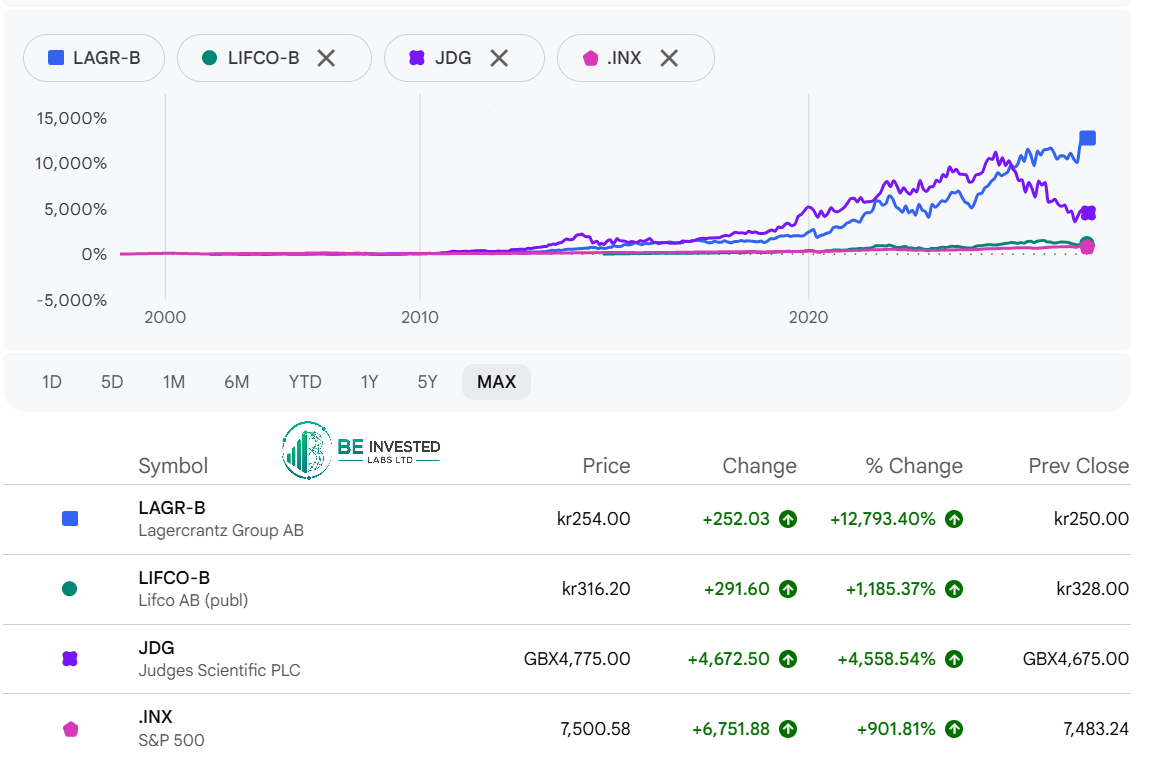
How do we assess "M&A diminish value" compared with"serial acquirers are Europe's best compounders"? To answer, this question we will analyse three specific conditions that works for serial acquirers. Before that, this article is part of three series of articles. First investors must understand the types of serial acquirers.
Chapter 1: The types of serial acquirers.
The following are three types of serial acquirers.
Hold-cos business model: buy anything good, without integrating.
This serial acquirers archetype buys business and holding them in their portfolio. A great example is Berkshire Hathaway. Hold-cos buy unrelated businesses across industries/sectors, keep management in place, and do not integrate. There are no synergies by design yet the value creation comes entirely from capital allocation at the head office. Hence, resources are made available for the underlying businesses to operate efficiently.
Buying good businesses at fair prices and redeploying the cash flows. European examples: Investor AB and Industrivärden (the Wallenberg and Handelsbanken spheres), EXOR (Agnelli family), and in a purer operating form, Sweden's Lifco which has 257 subsidiaries across dental, demolition tools, and systems solutions, run with radical decentralisation and an obsession with EBITA growth. Lifco has compounded free cash flow per share at ~21% since its 2014 IPO with minimal debt.
From economics perspective: Advantage is, there is no integration risk. The trade-off is that the model lives or dies on the capital allocator at the top. Keypersons or management are the main risk and the fragility. (Remember, the market's anxiety whenever Buffett's succession came up, or Lifco's panicked when star CEO Fredrik Karlsson departed to found Röko).
Roll-ups: homogenous build-up
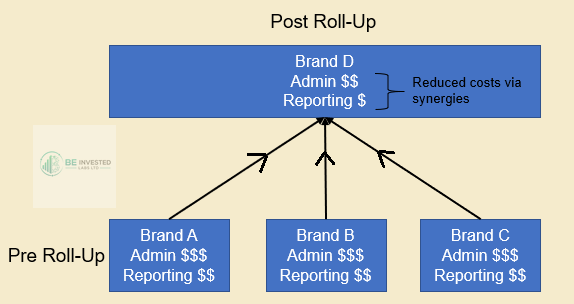
The roll-up type of serial acquirer buys business and integrates them in a unified body. Roll-ups consolidates businesses in their specific sector or industry. Think of waste managment companies, lab testing businesses, grocery chains businesses, veterinary and dental care businesses. The aim of these type of consolidation is to share resources, pricing power and increase market share.
In europe, we have the likes of Rentokil Initial (pest control), Bunzl (distribution, arguably a hybrid). In the world of consumer serial acquirers some cite1 Moët Hennessy Louis Vuitton (LVMH) is the king of “pure-play“ acquirer. Ahold Delhaize is also a well disciplined strategic acquirer example.
From economics perspective: Advantage of roll-ups is that they have real synergies meaning they buy small businesses at low prices and combine them into a larger one, increase their market share and reducing over the cost of operations. The disadvantage of roll-ups is the challenge of business cultural integration. Most roll-ups often use loans or some kind of debt to buy the underlying business which can cause cash flow issues.
Accumulators: decentralised capital allocation
Accumulators are a hybrid of hold-cos and roll-ups, hence of both worlds. These are very industry or sector specific such as vertical software companies, niche scientific instrument companies. The underlying businesses are not heavily integrated together. Each acquired company keeps its CEO and leadership. However, the parent company provides capital, shares best practises from one business to another, and a permanent home for founder-owned businesses.
In Europe, and especially the Nordics, they have world class accumulators such as Addtech, Indutrade, Lagercrantz, and Bergman & Beving, Halma and Diploma and Judges Scientific (in the UK), Constellation's European spin-off Topicus (in the Netherlands), Röko and Teqnion. Halma has completed 154 acquisitions since 1983, grown its dividend by 5%+ for over 40 consecutive years.
From economics perspective: Advantage is a well-organised accumulator can reinvest close to 100% of free cash flow at high incremental returns for decades. Because in Europe's fragmented Mittelstand and family-business landscape, accumulator offers an enormous advantage while reducing business cultural and integration friction. Some disadvantage, can organic growth stagnation since leadership can loose oversight of core businesses if they are too aggressive on only acquisition rather then growing the underlying business unit.
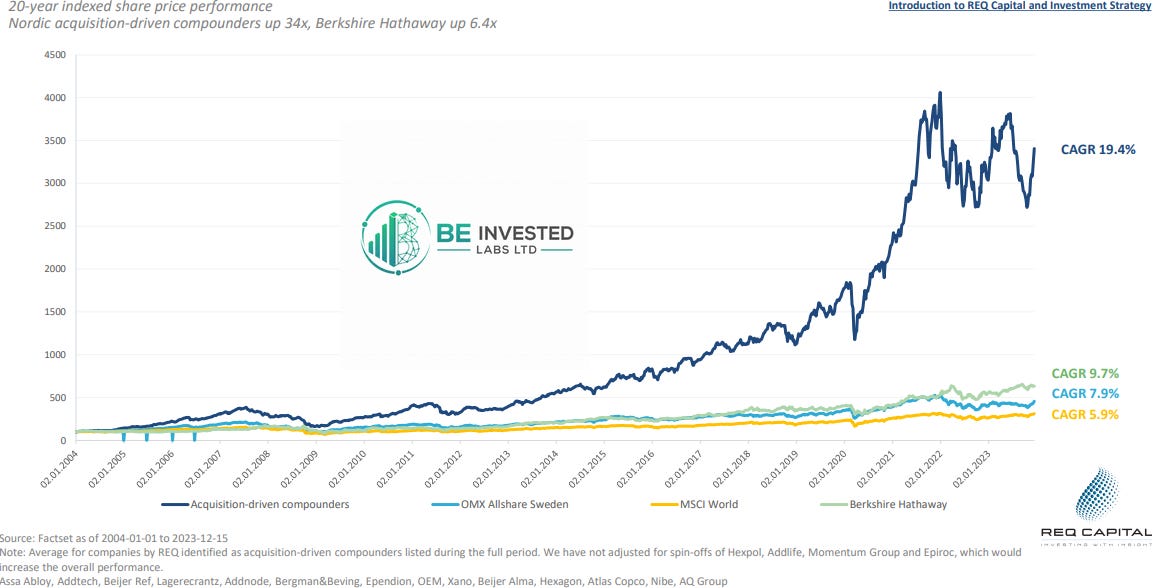
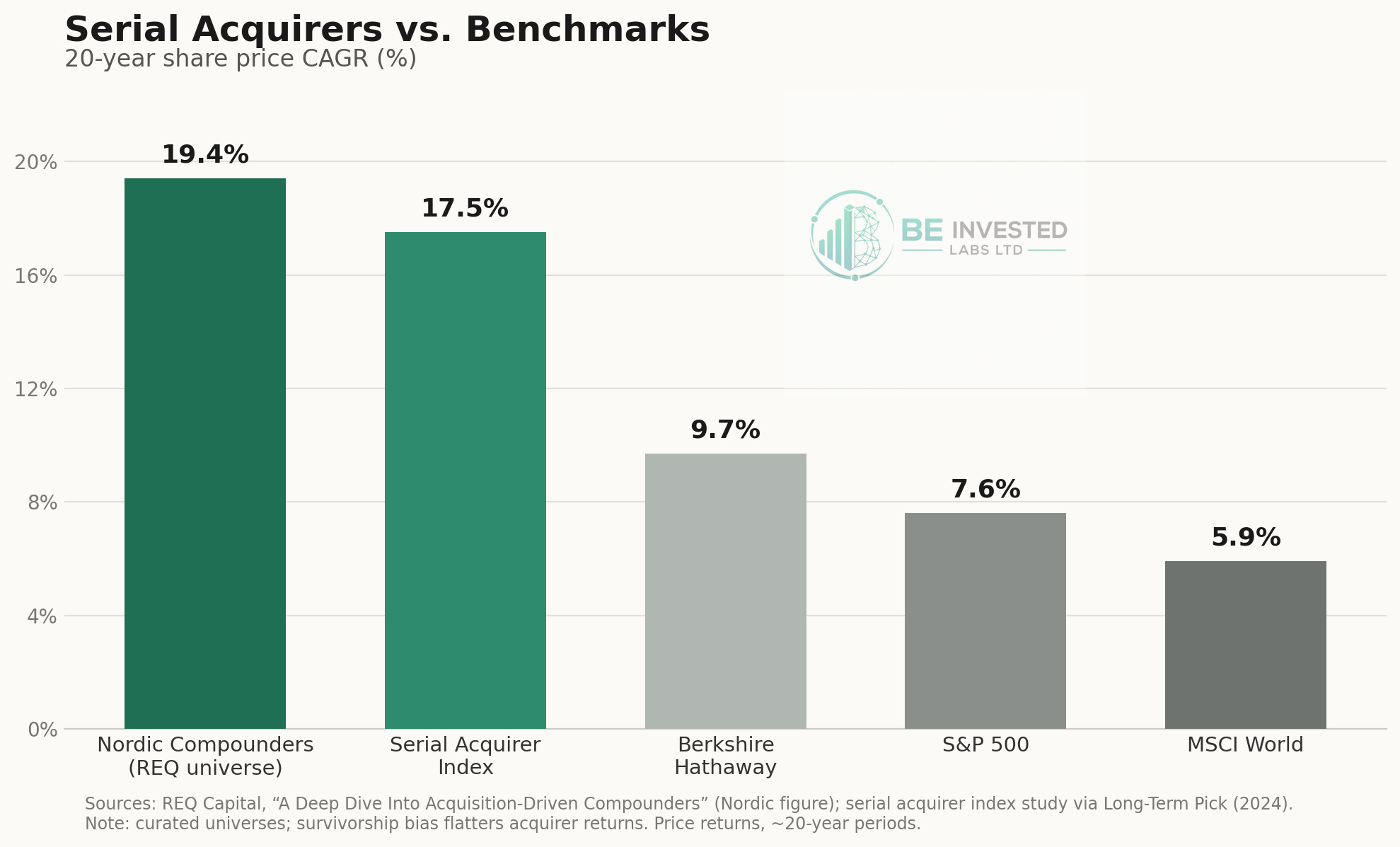
Now that you know the types of acquirers, our hypothesis about why does Europe have best value compounders will be answered in our next publication. But for now here is “a little treat” below (for the nerds and fact checkers). In REQ Capital's2 study of Nordic serial acquirers reveals that over 20 years. The found out the Nordic acquirers have average share price growth of 19.4% heavily outperforming MSCI World and OMX Stockholm.
Thanks for reading until next article.
Remember, to be curious, is to be invested!
https://quartr.com/insights/company-research/our-list-of-100-eminent-serial-acquirers
https://req.no/wp-content/uploads/2023/12/REQ-Deep-Dive-Acquisition-driven-Compounders-December-2023.pdf