



Every modern economy runs on chips. Understanding why requires going inside the machines that make them, understanding who controls those machines, and realizing what that control is worth.
Phones need them, cars need them, factories need them, hospitals need them, banks need them, satellites need them, gaming consoles need them, cloud platforms need them, and every serious AI model depends on them.
That is why semiconductors have moved from being a technical supply-chain topic to becoming one of the most important industries in the world. Chips now sit inside the biggest conversations in markets: artificial intelligence, national security, inflation, energy demand, industrial policy, data-centre capex, and the future of computing.
The industry has always been cyclical. Demand rises, companies build capacity, inventories reset, prices fall, and the market starts again. That cycle still matters. What has changed is the size of the demand driver now sitting on top of the old cycle.
AI has turned compute into a scarce resource. It has also turned memory bandwidth, advanced packaging, power efficiency, and leading-edge manufacturing into strategic assets.
This creates the main debate for investors.
Semiconductors have some of the strongest profit pools in public markets, but the value is not shared equally across the chain. The companies that control scarce technology, design software, AI architecture, leading-edge manufacturing, advanced memory, and equipment chokepoints capture the best economics. The weaker players still move with the cycle and can look cheap right before earnings fall.
Our view is clear: semiconductors remain one of the most important sectors for the next decade, but investors need to map the value chain before buying the story. ASML is not Micron. Micron is not NVIDIA. NVIDIA is not TSMC. TSMC is not Amkor. They belong to the same industry, but they do not have the same economics.
The short version
Semiconductors solve one large problem: the world keeps demanding more computation, more storage, more connectivity, and more control over electronic systems. That demand now comes from AI training, AI inference, cloud computing, smartphones, PCs, cars, factories, industrial machines, defence systems, medical devices, and connected products.
The business model changes depending on where the company sits in the chain. Some companies license IP. Some sell design software. Some design chips. Some manufacture chips. Some sell the machines used to manufacture chips. Some package and test the final product. Some distribute chips into fragmented customer markets.
The strongest profit pools are usually found in 5 areas: EDA and IP, fabless AI design, semiconductor equipment, leading-edge foundry, and high-bandwidth memory. These are the places where technical difficulty, customer dependency, scale, and switching costs create strong pricing power.
The industry also has real risks. Fabs are expensive. A leading-edge fab can cost tens of billions of dollars. EUV tools can cost hundreds of millions. Manufacturing cycles are long. Inventory can build quickly. Memory prices can rise fast and fall fast. Export controls can change demand overnight. Taiwan remains the biggest geographic risk in the global technology stack.
The next 5 years will probably be decided by 6 questions:
Can hyperscalers keep spending on AI infrastructure?
Can memory suppliers turn HBM demand into more stable long-term contracts?
Can TSMC keep leading at advanced nodes while managing Taiwan risk?
Can ASML continue to control the EUV and High-NA transition?
Can China’s mature-node expansion pressure pricing in older chips?
Can advanced packaging become a bigger profit pool as chiplets grow?
That is the whole industry debate.
Use BE Invested Labs to generate structured industry research, company breakdowns, bull and bear cases, valuation notes, and AI audio briefings.
Subscribe to BE Invested Labs for more industry breakdowns like this.
What semiconductors actually do
A semiconductor controls electrical signals. That sounds basic until you realise that modern life is built on the ability to control signals at enormous scale and speed.
Some chips process information. CPUs, GPUs, NPUs, AI accelerators, and custom ASICs fall into this group. They decide how fast a system can calculate, train, infer, render, simulate, or respond.
Some chips store information. DRAM, NAND, and high-bandwidth memory sit here. The AI world is learning this lesson very quickly: compute without memory bandwidth is limited.
Some chips move information. Networking chips, modems, RF chips, optical components, and connectivity chips allow devices and data centres to communicate.
Some chips manage power. Power semiconductors help convert, distribute, and control electricity. They matter in electric vehicles, factories, power grids, renewable energy, and data centres.
Some chips sense the physical world. Image sensors, accelerometers, temperature sensors, radar chips, and industrial sensors turn physical signals into digital information.
That is why the semiconductor market is much broader than AI GPUs. AI is the current centre of attention, but the industry also includes automotive chips, industrial chips, analog chips, memory, sensors, communications chips, microcontrollers, and power devices.
The useful investor question is simple: which chips are scarce, differentiated, and hard to replace?
That is usually where the money goes.
How the industry is structured
The semiconductor industry has 8 main layers.
Before walking through each one, here is the full value chain in one view:

1. Materials and chemicals
This is the base of the industry. Chip manufacturing needs silicon wafers, specialty gases, photoresists, wet chemicals, deposition materials, rare gases, ultra-pure water, and cleanroom infrastructure.
Key players include Shin-Etsu, SUMCO, Siltronic, GlobalWafers, Linde, Air Liquide, Air Products, JSR, Tokyo Ohka Kogyo, and other specialist suppliers.
This layer rarely gets the same attention as NVIDIA or TSMC, but it matters. A fab cannot run without the right materials at the right purity. Even small contamination can ruin wafers that have already absorbed weeks of process time and huge production cost.
Materials also create geopolitical exposure. Neon, helium, bromine, tungsten, rare earths, and specialty chemicals can become supply-chain issues very quickly when trade, war, export rules, or logistics routes change.
2. EDA software and IP
Before a chip can be manufactured, it must be designed.
That is where Electronic Design Automation, or EDA, comes in.
The main players here are Synopsys, Cadence, and Siemens EDA. Arm also sits in this upstream layer through processor architecture and IP licensing.
This is one of the best business models in the industry. EDA tools are deeply embedded inside engineering workflows. If a chip company is spending hundreds of millions on a new design, it will not risk failure by using weak tools. The cost of the software is small compared with the cost of a failed chip.
That gives EDA companies strong pricing power, high margins, recurring revenue, and exposure to the whole industry. They do not need to guess which AI chip wins. If the world keeps designing more complex chips, demand for design software and IP keeps rising.

3. Fabless design
Fabless companies design chips but outsource manufacturing.
This is where NVIDIA, AMD, Qualcomm, Broadcom, Marvell, MediaTek, Apple’s internal silicon teams, and many AI chip startups sit.
The model is attractive because fabless companies avoid the huge capex burden of owning fabs. They spend on architecture, software, engineers, product design, and customer relationships. If the product wins, returns on capital can be very high.
NVIDIA is the clearest example today. The company’s advantage is not only the GPU — it is the full AI computing stack: GPUs, networking, systems, CUDA, software libraries, developer adoption, and deep customer relationships with hyperscalers.
The weakness of the fabless model is dependence. A great chip design still needs TSMC, Samsung, advanced packaging, HBM supply, substrates, and testing capacity. The chip can be designed perfectly and still be constrained by manufacturing or packaging supply.
4. Semiconductor equipment
This is the machinery layer.
Fabs need tools for lithography, etching, deposition, inspection, metrology, cleaning, ion implantation, process control, and testing.
Key players include ASML, Applied Materials, Lam Research, Tokyo Electron, KLA, Advantest, and Teradyne.
This is one of the strongest parts of the value chain because the equipment is hard to build and hard to replace. A fab can change some suppliers over time, but it cannot avoid using highly specialised tools.
ASML has the most obvious chokepoint. It is the only supplier of EUV lithography systems, which are needed for leading-edge chips. No EUV means no leading-edge production at scale.
KLA also matters because fabs need inspection and metrology to control yield. In a high fixed-cost industry, yield is money. A small yield improvement can have a large impact on gross margin because the wafer cost is already incurred.

5. Foundries and IDMs
Foundries manufacture chips for other companies.
TSMC is the leader. Samsung Foundry is the other major advanced-node competitor. GlobalFoundries, UMC, and SMIC focus more on mature and specialty nodes.
IDMs design and manufacture their own chips. Intel, Samsung Electronics, Texas Instruments, Analog Devices, STMicroelectronics, Infineon, NXP, and Micron all have elements of this model, depending on the product category.
Manufacturing is where the industry becomes physically difficult. Fabs require extreme precision, cleanrooms, power, water, process knowledge, expensive tools, long production cycles, and large engineering teams.
The economics are powerful when utilisation is high. Fixed costs get spread across more wafers, and margins can expand quickly. The same model becomes painful when demand falls. Fixed costs remain even when volumes drop.
That is why foundries and IDMs must be analysed through utilisation, capex, yield, node leadership, and customer commitments.
6. Memory
Memory stores data.
The main categories are DRAM and NAND. The main public players are Samsung, SK Hynix, and Micron.
Historically, memory has been more cyclical than logic. Supply gets tight, pricing rises, profits expand, capacity gets added, supply catches up, pricing falls, and margins compress.
AI has changed the memory debate because high-bandwidth memory, or HBM, is now essential for AI accelerators. GPUs need HBM to feed data fast enough. Without memory bandwidth, expensive compute sits underused.
This has made memory more strategic. Micron, SK Hynix, and Samsung are now trying to secure longer-term customer commitments, pricing floors, and take-or-pay structures. That could reduce some cyclicality, but investors should be careful. Memory has improved, but it has not become software.
The key question is whether HBM creates a more disciplined memory industry, or whether the old cycle returns once supply catches demand.
7. Advanced packaging and testing
After wafers are processed, chips must be cut, packaged, connected, tested, and qualified.
This is where OSAT companies such as ASE Technology, Amkor, and JCET operate. TSMC, Samsung, Intel, and memory companies also invest heavily in advanced packaging internally.
This layer used to be viewed as lower-margin back-end work. That view is changing because AI systems now depend on advanced packaging.
Chiplets, HBM, 2.5D packaging, 3D stacking, interposers, and CoWoS-like technologies allow multiple dies to work together inside one package. As transistor scaling becomes harder and more expensive, packaging becomes a bigger part of performance.
The industry is moving from “make the transistor smaller” to “connect more specialised silicon more efficiently.”
That makes advanced packaging one of the most important areas to watch.
8. Distributors and end customers
Distributors such as Arrow Electronics and Avnet help move chips into fragmented customer markets. Their margins are usually lower than the margins earned by IP owners, equipment makers, or leading chip designers.
End customers include Apple, Samsung, Tesla, Microsoft, Amazon, Google, Meta, Oracle, automotive OEMs, industrial companies, defence contractors, telecom equipment makers, and thousands of smaller electronics producers.
The demand signal starts here. If hyperscalers keep spending, AI chips, HBM, networking, storage, power chips, and advanced packaging stay tight. If automotive demand slows, mature-node chips feel it.

Where the money is made
The semiconductor industry has several profit pools, but they are not equal.
The strongest economics sit where customers have few alternatives.
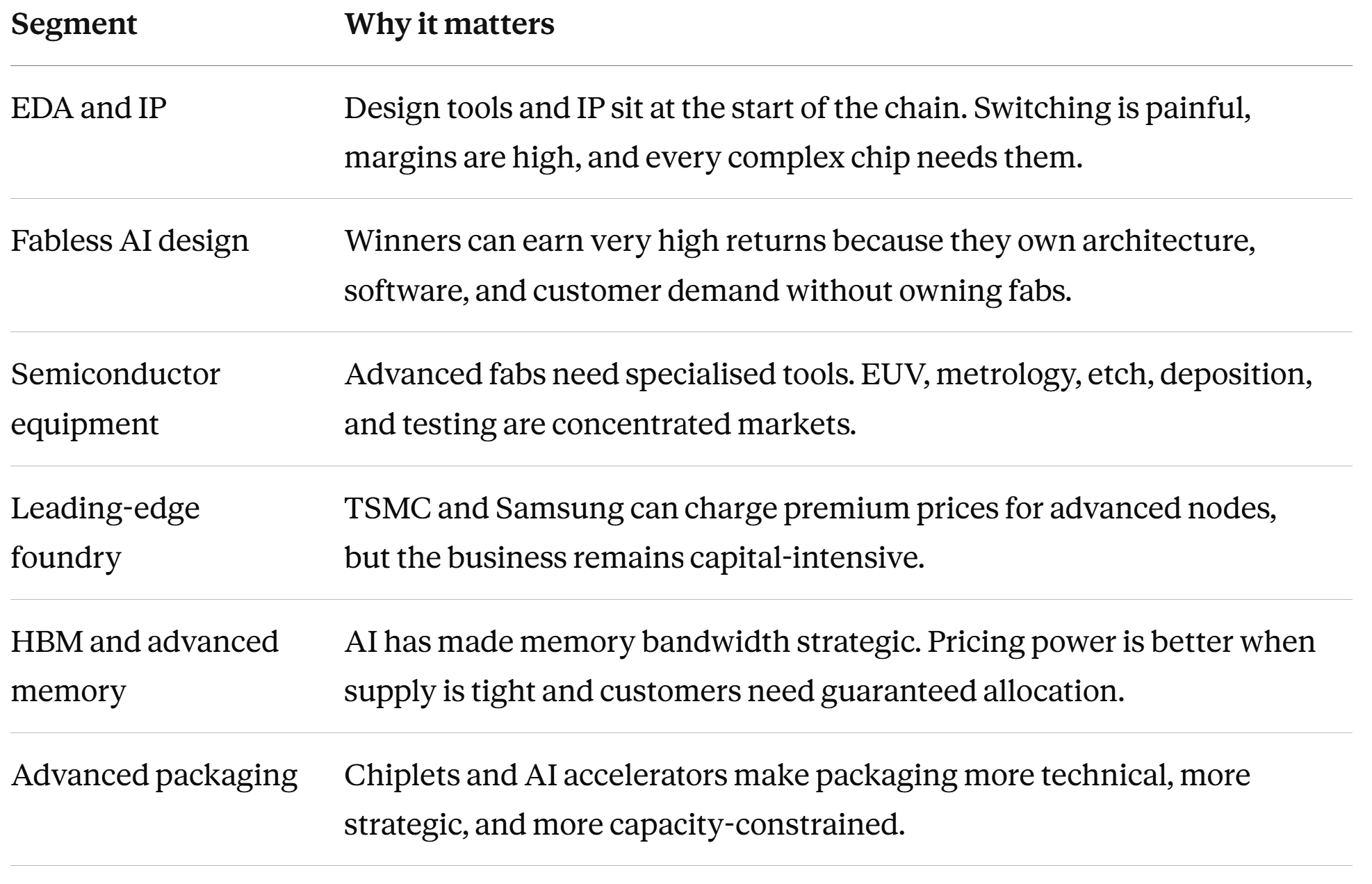
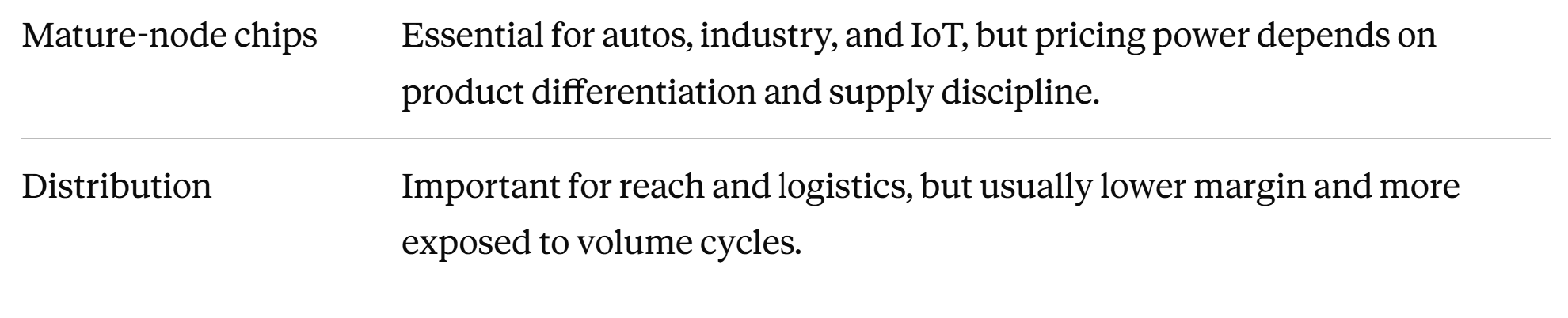
The highest and most consistent returns often come from EDA/IP and selected equipment companies. These companies sell into the whole industry without taking full fab risk.
Fabless leaders can also produce exceptional returns when they own the demand layer. NVIDIA is the current example.
Foundries are strong when they lead at advanced nodes, but they must keep reinvesting heavily.
Memory can produce huge profits in tight markets, but the valuation must reflect the cycle.
Why the economics are attractive
The semiconductor industry has strong economics because the products are essential, the barriers are high, and the best companies control scarce capabilities.
Technical difficulty. Modern chips are hard to design and hard to manufacture. This protects incumbents because new entrants cannot simply raise money and compete at the leading edge.
Scale. Large companies spread R&D, manufacturing learning, customer support, process development, compliance, and supplier relationships across huge revenue bases.
Switching costs. Chip designers do not easily switch EDA tools. Fabless companies do not easily move leading-edge production away from TSMC. Customers do not easily redesign products around a new chip supplier. Fabs do not easily replace key equipment vendors.
Operating leverage. Once fixed costs are covered, incremental revenue can flow strongly into margins. This works beautifully in an upcycle. The same leverage cuts both ways. When demand falls, utilisation drops, inventory rises, and fixed costs stay.
That is the danger of buying a cyclical stock on peak earnings.
Why the economics are dangerous
The industry is capital-intensive.
Fabs cost billions. Tools cost hundreds of millions. Process development takes years. Product cycles can be long. Inventory can become a problem before management teams admit it.
The cash conversion cycle is also long for many semiconductor manufacturers. A wafer can take months to move through production, packaging, testing, delivery, invoicing, and collection.
Fabless companies usually have better capital efficiency because they do not own fabs. Equipment makers can sometimes benefit from customer deposits and long backlogs. Foundries and IDMs carry much heavier capital burdens.
This is why investors must separate the business model before comparing valuation multiples.
A 25x earnings multiple for an EDA company is not the same as a 25x multiple for a memory company.
A low P/E in memory can be a warning.
A high P/E in EDA can still be justified if revenue is recurring, margins are high, and customer lock-in is strong.
AI changes the industry
AI is the largest current demand driver in semiconductors. The market often talks about AI as if it is only a GPU story. That is too narrow.
AI affects the full chain.
It affects NVIDIA through accelerators and systems. It affects TSMC through leading-edge manufacturing demand. It affects ASML through advanced lithography. It affects Micron, SK Hynix, and Samsung through HBM and DRAM. It affects Broadcom and Marvell through networking and custom silicon. It affects Synopsys and Cadence through chip complexity. It affects ASE, Amkor, TSMC, Intel, and Samsung through advanced packaging. It affects power semiconductors because AI data centres need more power management. It affects cooling, energy, and grid infrastructure because AI data centres consume far more electricity than traditional compute facilities.
The real question is whether AI capex produces enough return for hyperscalers.
If Microsoft, Amazon, Google, Meta, Oracle, and other large buyers keep increasing AI infrastructure spending, the semiconductor chain stays supported. If AI returns disappoint, spending can slow quickly — and that would hit the sector because semiconductors sit upstream of the AI buildout.
Memory has become the market’s signal
Micron has become more important because memory is now one of the cleanest signals for AI infrastructure demand.
HBM is no longer a side product. It is a key input for AI accelerators.
This has changed investor perception of memory companies. In the past, memory was often treated as a commodity cycle. Now, large customers are signing longer-term agreements because they need secure supply.
A take-or-pay agreement changes the quality of demand. Customer deposits, pricing floors, and longer commitments can reduce some of the old boom-bust behaviour.
But discipline is still needed.
Memory supply can increase. Competitors can add capacity. China’s CXMT can become more relevant in standard DRAM. HBM technology leadership can shift. AI customers can renegotiate if the cycle weakens.
The memory story is better than before. It is still cyclical. That is the balance investors need to keep.
Chiplets and advanced packaging are becoming strategic
Moore’s Law is becoming harder and more expensive.
The old playbook was simple: shrink transistors, improve performance, reduce cost per function, repeat.
That still matters, but the economics are more difficult at the leading edge.
Chiplets offer another path. Instead of building one large monolithic chip, companies split the system into smaller dies and connect them inside an advanced package. The performance-critical parts can use the newest node. Less demanding functions can use older, cheaper nodes.
This can improve yield, reduce cost, shorten design cycles, and allow companies to combine different technologies more efficiently.
AMD has shown the value of chiplets. Intel is investing heavily in packaging. TSMC has become central through CoWoS and other advanced packaging technologies. Memory suppliers also benefit because HBM must be integrated close to AI accelerators.
Investors should watch advanced packaging capacity the same way they watch wafer capacity. In AI, both can become bottlenecks.
Geopolitics now shapes the sector
Semiconductors used to be organised around efficiency: design in the US, equipment from the Netherlands, Japan, and the US, manufacturing in Taiwan and South Korea, assembled across Asia.
That model lowered cost and created dependency.
Now governments see chips as strategic assets.
The US has the CHIPS and Science Act — roughly $280 billion, with $52.7 billion specifically for domestic semiconductor manufacturing. Europe has the EU Chips Act, mobilising €43 billion. China is pushing self-sufficiency with over $150 billion in public funding and a target of 80% self-sufficiency by 2030. Japan is rebuilding its role in materials, equipment, and manufacturing. South Korea remains central to memory.
Taiwan remains central to advanced foundry capacity — and producing over 90% of the world’s most advanced chips through TSMC alone. This concentration is the single largest systemic risk in global technology. Any disruption to Taiwan creates cascading failures across every industry that depends on modern electronics.
This creates a more regional and more expensive industry. More fabs will be built outside Taiwan. More supply chains will be duplicated. More governments will subsidise capacity. More export rules will shape where companies can sell.
Geopolitics is no longer a footnote. It is part of the financial model.
The main public players
ASML controls one of the gates into leading-edge manufacturing. Its EUV monopoly is its core asset. The bull case is advanced-node demand, High-NA EUV adoption, and service revenue. The risk is export controls, China exposure, and customer capex timing.
TSMC is the world’s leading pure-play foundry. Its strength is manufacturing execution, customer trust, scale, and yield. The bull case is AI, custom silicon, and pricing power at advanced nodes. The risk is Taiwan concentration.
NVIDIA is the leading AI accelerator company. Its strength is GPUs, networking, systems, CUDA, software libraries, and customer relationships. The bull case is continued hyperscaler capex and inference growth. The risk is valuation, customer concentration, custom silicon competition, and export controls.
Synopsys, Cadence, and Arm sit upstream. They benefit from chip complexity. AI chips, automotive chips, chiplets, and custom silicon all require more design work. The bull case is that complexity keeps rising. The risk is valuation and future AI-assisted design disruption.
Applied Materials, Lam Research, Tokyo Electron, and KLA sell tools into fabs. The bull case is global fab expansion, advanced nodes, and AI demand. The risk is capex cyclicality and China restrictions.
Micron, SK Hynix, and Samsung are the memory leaders. AI has made HBM strategic. The bull case is tight HBM supply, disciplined DRAM production, and long-term customer contracts. The risk is supply catching up, pricing falling, and China capacity growing. Memory is better than before. It is still memory.
Intel is the turnaround case — scale, customer relationships, manufacturing assets, and strategic value to the US. The bull case is government support and process recovery. The risk is executing on too many fronts simultaneously.
AMD, Broadcom, Marvell, and Qualcomm sit across high-performance computing, networking, custom silicon, mobile, and connectivity. The bull case is custom silicon and diversified AI infrastructure demand. The risk is competition and customer concentration.
ASE and Amkor sit in packaging and test. Advanced packaging is improving the strategic value of the back end. The bull case is chiplets, HBM integration, and AI accelerator complexity. The risk is that standard packaging remains competitive and margin-limited.
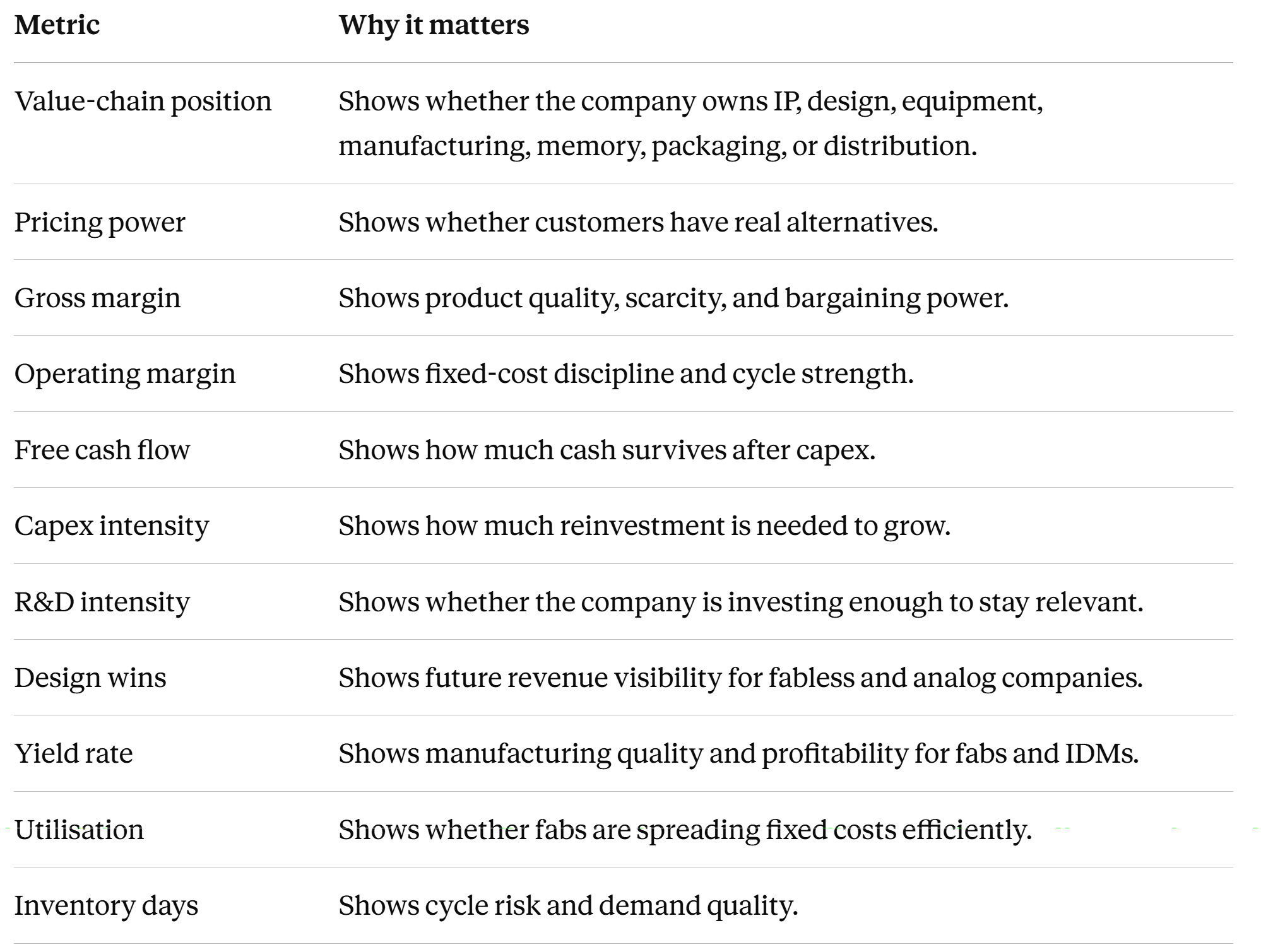
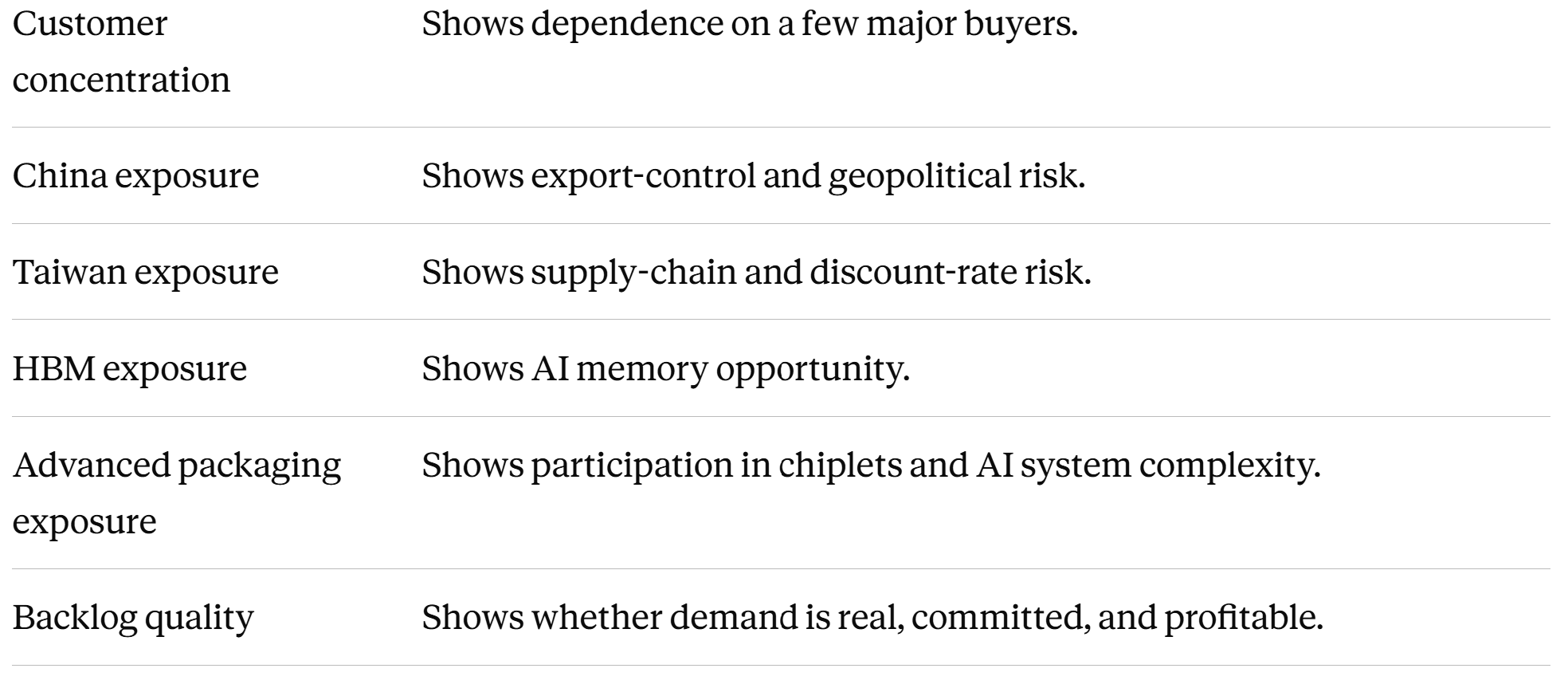
How to analyse a semiconductor company
Investors should avoid analysing all chip companies with one metric.
Revenue growth alone is not enough. P/E alone is not enough.
The 5-year scenarios
Base case (60% probability): AI demand remains strong but uneven. Hyperscaler capex continues, but investors become more selective. Memory remains healthier than past cycles because of HBM and longer-term contracts, but pricing still moves in waves. Equipment demand remains supported because governments and companies keep building fabs across regions. The winners are companies with pricing power, advanced technology, strong balance sheets, and exposure to AI infrastructure without relying on perfect conditions.
Bull case (20% probability): AI spending continues to exceed expectations. Training grows, inference grows, enterprise AI adoption becomes measurable, sovereign AI expands, custom silicon grows alongside GPUs, HBM remains tight, and advanced packaging becomes a major bottleneck. This would support fabless AI leaders, HBM suppliers, leading-edge foundries, EDA companies, advanced packaging players, and equipment leaders. The danger is overpaying for the obvious winners.
Bear case (20% probability): AI spending slows before revenue catches up. Hyperscalers reduce capex growth, memory supply catches demand, foundry utilisation weakens, equipment orders get pushed out, and China pressures mature nodes. This would punish companies priced for perfect growth. The weakest stocks would be companies with high cyclicality, low pricing power, heavy capex, or stretched valuations.
What BE Invested Labs is watching
For the semiconductor sector, we are tracking 12 signals:
Hyperscaler capex from Microsoft, Amazon, Google, Meta, Oracle, and other large AI buyers
NVIDIA data-centre growth and forward commentary
HBM pricing, capacity, and supplier share across SK Hynix, Micron, and Samsung
Micron’s customer commitments and whether memory contracts reduce cyclicality
ASML bookings, backlog, China exposure, and High-NA EUV adoption
TSMC utilisation, advanced-node pricing, and CoWoS capacity
Semiconductor equipment orders from Applied Materials, Lam Research, Tokyo Electron, and KLA
DRAM and NAND pricing outside HBM
Export-control updates from the US, Netherlands, Japan, China, and the EU
Advanced packaging capacity and lead times
Inventory trends across automotive, industrial, consumer electronics, and data-centre customers
Power, water, labour, and permitting constraints for new fabs
The most important signal remains AI capex. If AI infrastructure spending holds, the sector has support. If AI infrastructure spending slows, the market will quickly test which semiconductor companies have real durability.
Our view
Semiconductors are still one of the most important sectors in the market.
The customer problem is real. The world needs more compute, more memory, more networking, more power efficiency, and more manufacturing capacity.
The industry also remains cyclical, capital-intensive, politically exposed, and valuation-sensitive.
Our view is constructive but selective.
The best companies control scarce parts of the chain. EDA controls design workflows. ASML controls EUV. TSMC controls advanced manufacturing scale. NVIDIA controls the AI accelerator stack. Memory leaders control HBM supply, though the cycle still matters. Advanced packaging is becoming more important as chiplets grow.
For investors, the cleanest approach is to separate business quality from price. A great semiconductor company can still be a bad buy at the wrong valuation. A cyclical semiconductor company can look cheap right before earnings fall.
The winners will show 4 things clearly:
Customers need what they sell.
Competitors cannot easily copy it.
Margins survive normal cycle pressure.
Free cash flow grows over time.
Map the value chain. Find the chokepoints. Follow the profit pools. Then ask whether the price gives you enough margin of safety.
A note on this collaboration: this breakdown was co-written with Gidion from Behind The Chip, a Substack publication dedicated to exploring the people, physics, and principles behind semiconductor innovation. His knowledge of the industry's technical depth made this article better. If you want to understand what's happening inside the machines that power this supply chain — not just the economics — his newsletter is the right place to go. Subscribe at behindthechip.substack.com.
Try the BE Invested Labs platform: beinvestedlabs.com
Subscribe to BE Invested Labs for more industry breakdowns, company research, bull and bear cases, valuation notes, and AI audio briefings.
— Buyce & Emmanuel, BE Invested Labs
References and data notes
Sources used for this breakdown include BE Invested Labs semiconductor industry reports covering business models, core economics, value-chain mapping, unit economics, regulation, TAM, future growth scenarios, geopolitics, and macro outlook. We also reviewed recent public market reporting on semiconductor sales, AI capex, HBM demand, memory supply commitments, Micron, SK Hynix, ASML, TSMC, and SEMI commentary.
Disclaimers & Disclosures
AI Transparency BE Invested Labs uses AI to aggregate financial data and format reports. The AI structures the information. Users determine their own investment thesis, risk management, and market outlook. We audit system outputs to reduce AI errors. We use these exact reports to manage our own capital.
Legal Disclaimer This platform provides educational and informational content. BE Invested Labs is not a registered investment adviser and does not provide financial, investment, tax, or legal advice. Nothing in this article is a recommendation to buy, sell, or hold any security. Investors should do their own research and consult a qualified professional before making investment decisions.
This is an impressive master class on the semiconductor value chain! Great pointer to where to be “invested” to get the value out of this hidden value stream. Worth bookmarking, and subscribing for more valuable insights.
This is one of the most comprehensive semiconductor breakdowns I've read.
You've done something rare here — you've taken a complex, layered industry and mapped it in a way that's both technically accurate and financially useful. The distinction between the profit pools is what makes this valuable. EDA is not equipment. Equipment is not foundry. Foundry is not memory. Memory is not packaging. They all sit in the same industry, but they do not have the same economics.
And that's where most analysis fails.
What strikes me is how this industry mirrors something larger — the question of who controls the chokepoints. The companies that capture the best economics aren't just the ones with the best technology. They're the ones that control scarcity. ASML controls EUV. TSMC controls advanced manufacturing at scale. NVIDIA controls the AI stack. Memory suppliers control HBM supply. Each is a gatekeeper.
At The Modern Lens, we explore the same question — but applied to structures beyond semiconductors. Who controls the chokepoints in information? In history? In the stories we're told? The mechanisms are different, but the pattern is the same: scarcity creates power.
I wrote about this in a piece called "A Shell on the Riverbed" — about how we tried to understand the universe, and why we missed the most important thing. About the things we search for, and the things we let slip away.
And in "The Digital Testament" — about leaving a trace, about proving that we were here, that we tried. About what we build that outlasts us.
This breakdown is a reminder that understanding the structure — whether in chips or in society — is the first step to seeing clearly. Thank you for this.