



Every serious business has the same problem.
Customers speak to sales. They open support tickets. They click emails. They visit websites. They attend demos. They complain. They renew. They leave.
Somewhere inside all of that activity is the truth about the customer relationship.
That is the job CRM software gets paid to organise.
Customer Relationship Management, or CRM, sounds boring until you realise how much money sits behind it. The best CRM platforms sit close to revenue, retention, support cost, sales productivity, marketing spend, forecasting, and customer data. That is why the category has produced Salesforce, HubSpot, Microsoft Dynamics, ServiceNow, Adobe Experience Cloud, Oracle CX, SAP Customer Experience, Zoho, Zendesk, Freshworks, and a long list of specialised tools.
The industry is moving again because AI is now sitting inside the workflow.
A good CRM used to tell the sales team what happened.
The next version of CRM will be judged by what it can do without waiting for a human to click 12 buttons.
That creates the main debate for investors.
CRM and cloud software have some of the best economics in public markets: recurring revenue, high gross margins, low capital intensity, strong switching costs, and negative working capital. The risk is that AI changes how customers pay for software, how many seats they need, and which vendor controls the customer record.
Our BE Invested Labs view is clear: CRM is still one of the strongest enterprise software profit pools, but the winners will change. The best companies will own customer data, workflow depth, integrations, trust, security, and measurable AI adoption. The weaker companies will become expensive dashboards sitting on top of messy data.
Prefer to listen?
We generated a BE Invested Labs audio briefing for this CRM and cloud software breakdown. It covers the industry structure, the main players, the AI disruption risk, the bull case, the bear case, and what we are watching next.
The short version
CRM software solves 5 problems:
Customer data is scattered across emails, spreadsheets, calls, support tools, websites, and sales notes.
Sales teams waste time updating pipelines and chasing weak leads.
Marketing teams send campaigns without enough customer context.
Support teams answer customers without seeing the full history.
Management struggles to forecast revenue, churn, customer behaviour, and team performance.
The business model is mostly subscription SaaS.
Customers pay monthly or annually. Pricing is usually based on users, product tier, features, data usage, AI usage, automation volume, or enterprise contracts. Vendors then make more money through add-ons, integrations, data products, AI features, professional services, and partner marketplaces.
The economics are attractive because software is cheap to deliver once built.
A top CRM company can generate gross margins in the 70% to 85% range. The main costs sit in engineering, sales, marketing, customer success, cloud hosting, compliance, and support. As revenue scales, the best operators can turn more of each extra dollar into operating profit and free cash flow.
The industry has 2 different market structures at the same time.
Enterprise CRM is controlled by a small group of large platforms: Salesforce, Microsoft, Oracle, SAP, Adobe, ServiceNow, and a few others.
Mid-market and SMB CRM is more fragmented. HubSpot, Zoho, Freshworks, Monday.com, Pipedrive, Zendesk, and specialised vertical players can still grow because smaller companies want simpler tools, lower prices, and faster setup.
The next 5 years will probably be decided by 4 questions:
Can CRM vendors turn AI agents into paid usage?
Will customers pay more for automation if seat growth slows?
Can incumbents defend their data and workflow advantage against AI-native startups?
Will regulation and data sovereignty make scale more important?
That is the whole industry debate.
If you want structured research like this on companies, industries, and market themes, visit beinvestedlabs.com and try the BE Invested Labs research platform.
What CRM actually does
CRM is the system companies use to manage customer relationships across sales, marketing, service, commerce, and analytics.
For a small business, that may mean tracking leads and sending follow-up emails.
For a large enterprise, CRM becomes a large operating layer across sales reps, service agents, account managers, marketing teams, commerce teams, finance, data teams, and senior management.
A bank may use CRM to manage customer onboarding, branch activity, complaints, loan offers, and compliance records.
A software company may use CRM to track leads, pipeline stages, product usage, renewals, support tickets, customer health scores, and expansion opportunities.
A retailer may use CRM to segment customers, run loyalty campaigns, personalise offers, and handle post-purchase support.
A hospital group may use CRM to manage patient communications, appointment follow-ups, insurance interactions, and service feedback.
The value is simple: better customer memory.
The more a business remembers about its customers, the better it can sell, support, retain, and forecast.
That memory has financial value.
Sales leaders care because CRM affects pipeline accuracy and sales productivity.
Marketing leaders care because CRM affects segmentation and campaign return.
Support leaders care because CRM affects resolution time and customer satisfaction.
Finance leaders care because CRM affects revenue visibility, renewal risk, and forecasting.
Investors should care because CRM sits close to the customer budget.
A company can delay a new office. It can delay new furniture. It is harder to delay the system that tracks revenue, customer history, support tickets, and renewals.
How the industry is structured
The CRM and cloud software market has 4 layers.
1. Cloud infrastructure
This is the base layer: AWS, Microsoft Azure, Google Cloud, Oracle Cloud, and other infrastructure providers.
CRM vendors use cloud infrastructure for compute, storage, databases, networking, security, AI workloads, and global availability. This layer is capital intensive. It requires data centres, chips, energy, cooling, fibre networks, and long-term infrastructure spending.
The infrastructure providers have scale advantages because they buy hardware, power, and networking capacity at levels smaller companies cannot match.
For CRM vendors, cloud infrastructure is both an enabler and a cost line.
The cost line matters more now because AI workloads can be expensive. If AI agents become part of everyday CRM usage, inference cost, latency, model routing, and data retrieval will become important margin drivers.
2. Data and integration
This layer includes data warehouses, integration tools, API platforms, ETL tools, identity tools, middleware, and security systems.
Examples include Snowflake, Databricks, MuleSoft, Informatica, Workato, Okta, Cloudflare, and many others.
This layer matters because CRM data rarely lives in one clean place.
Sales data may sit in Salesforce. Product usage may sit in Snowflake. Billing may sit in Stripe or NetSuite. Support may sit in Zendesk. Marketing may sit in Adobe, HubSpot, or Braze. Finance may sit in SAP or Oracle.
The CRM platform becomes more useful when these systems speak to each other.
This is why Salesforce bought MuleSoft in 2018, Tableau in 2019, Slack in 2021, and later moved again into data management with Informatica. The direction is clear: Salesforce wants to own more of the customer data layer, not only the sales database.
3. CRM and application software
This is the visible layer.
Salesforce sells Sales Cloud, Service Cloud, Marketing Cloud, Commerce Cloud, Data Cloud, Slack, Tableau, MuleSoft, and Agentforce.
Microsoft sells Dynamics 365 and connects it with Microsoft 365, Teams, Azure, Power Platform, Copilot, LinkedIn, and its enterprise identity stack.
HubSpot sells marketing, sales, service, content, and operations software, with a strong position in SMB and mid-market.
ServiceNow is stronger in workflow, IT service management, enterprise service delivery, and customer service operations.
Adobe is stronger in marketing, analytics, content, personalisation, and experience management.
Oracle and SAP are stronger where CRM connects deeply into ERP, finance, supply chain, procurement, and large enterprise systems.
This layer earns the best margins when the software becomes part of daily work.
4. Implementation and services
Large CRM projects need consultants, system integrators, migration teams, developers, admin teams, and training.
This is where Accenture, Deloitte, Capgemini, Cognizant, IBM Consulting, Infosys, Wipro, EPAM, and specialised Salesforce and Microsoft partners make money.
The services layer usually has lower margins than software, but it matters for adoption.
A CRM tool that is poorly implemented becomes an expensive database with low usage.
A well-implemented CRM tool can change sales behaviour, support quality, renewal discipline, and management visibility.
Where the money is made
The best profit pool is core SaaS software.
The reason is straightforward. Once the platform has been built, the cost of adding another customer is low compared with the subscription revenue that customer pays.
A mature CRM vendor can sell the same product to thousands of companies, keep improving the code, and charge recurring fees every year.
The strongest revenue streams are:
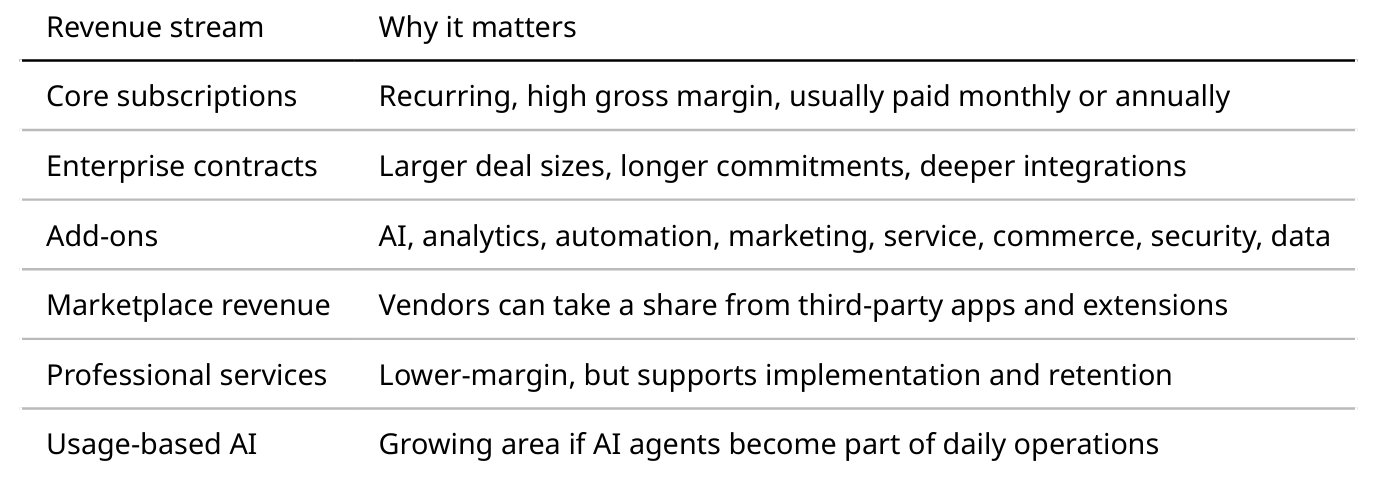
The best CRM companies turn one product into several products.
A customer may start with sales automation, then add support, marketing, commerce, data, analytics, Slack, AI agents, and industry-specific workflows.
That expansion is what investors want to see.
A good CRM business does not rely only on new customers. It grows inside existing accounts.
That is why net revenue retention matters.
If a company keeps customers and expands annual spend inside those customers, the sales engine becomes more efficient. The company does not need to replace lost revenue every year before growing.
Why the economics are so attractive
CRM and cloud software usually have 5 economic advantages.
High gross margins
Many SaaS companies can generate gross margins between 70% and 85%.
That does not mean they are automatically profitable.
Sales and marketing, R&D, stock-based compensation, cloud hosting, data costs, and customer success can consume a lot of revenue.
The gross margin still gives the business room to produce strong profit when growth costs become more efficient.
Recurring revenue
Annual or monthly subscriptions give better revenue visibility than one-time licence sales.
This makes the business easier to forecast.
It also makes the company more valuable in public markets, especially when churn is low and renewal rates are high.
Negative working capital
Many SaaS customers pay in advance.
The vendor receives cash before recognising all the revenue. That creates deferred revenue on the balance sheet and can improve operating cash flow.
This is one of the quiet advantages of SaaS.
The company can use customer prepayments to fund product development, support, sales, and infrastructure.
Low capital intensity
A CRM company does not need to build factories for every new customer.
Most capital goes into software development, people, cloud infrastructure, internal systems, offices, and acquisitions.
Salesforce is a good example. Its annual revenue is measured in tens of billions, while capital expenditure remains small relative to revenue.
The main investment is human talent and product development.
Strong switching costs
CRM sits inside sales processes, support processes, customer data, compliance records, workflows, dashboards, integrations, and management reporting.
Changing CRM is painful.
Data has to move. Teams need training. Integrations need rewriting. Reports break. Sales operations slow down. Customer records get messy.
This gives incumbents pricing power.
It also gives buyers a reason to stay with a tool they complain about.
That is why CRM can be unpopular with users and still financially powerful.
The 7 powers view
Here is how BE Invested Labs would read the CRM industry through the 7 Powers framework
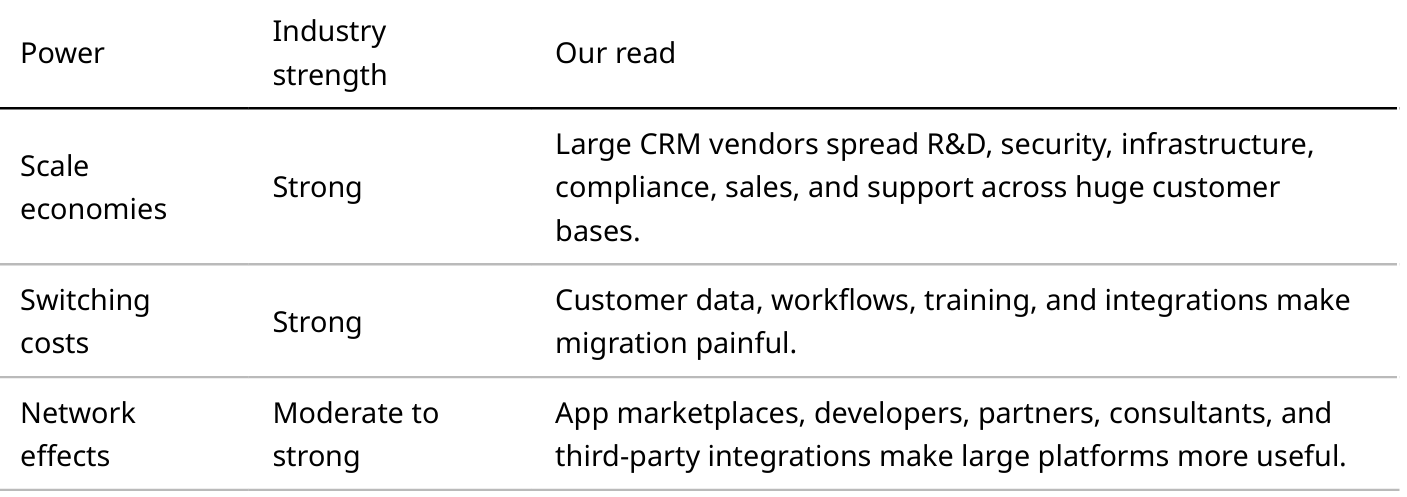
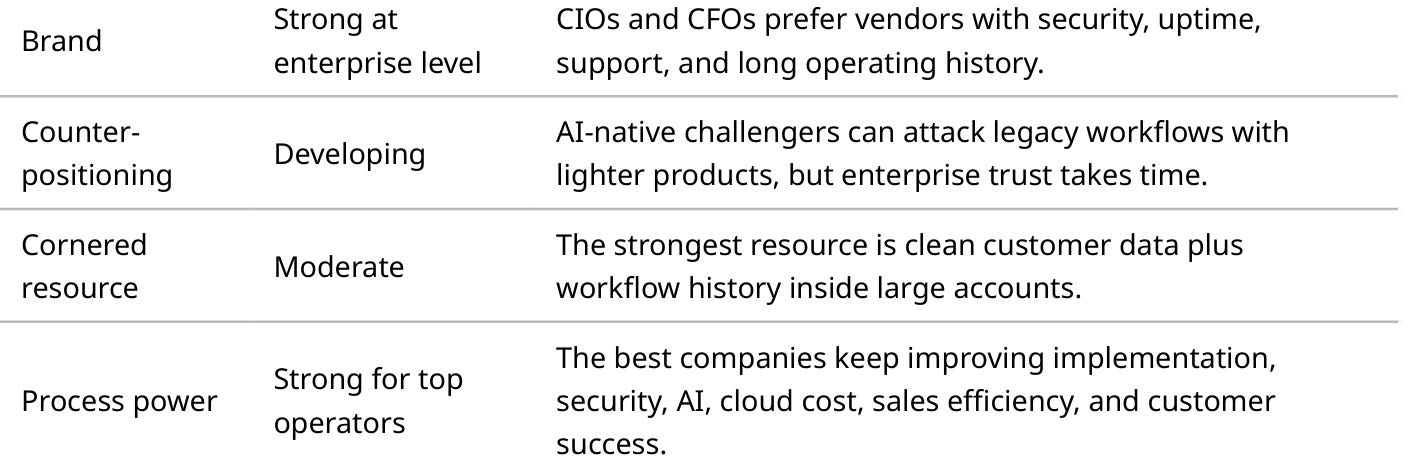
The strongest powers are switching costs, scale, brand, and partner networks.
Switching costs protect incumbents.
Scale funds R&D and compliance.
Brand helps win enterprise deals.
Partner networks make the product more useful than the software alone.
The weakness is user frustration.
Many CRM systems are powerful but heavy. Sales teams complain about data entry. Support teams complain about fields and processes. Managers complain about data quality. This creates room for simpler tools, AI-native interfaces, and vertical-specific software.
A company can be protected and vulnerable at the same time.
That is the tension inside CRM.
The main public players
Salesforce
Salesforce remains the reference company for cloud CRM.
It created the modern SaaS CRM category and still has one of the strongest platforms in enterprise software. Salesforce has sales, service, marketing, commerce, analytics, integration, collaboration, data, and AI products.
The current debate is growth.
Salesforce is already huge. It reported $41.5B in annual revenue for fiscal 2026 and guided fiscal 2027 revenue around $45.8B to $46.2B. In Q1 FY2027, Salesforce reported around $11.1B of revenue, up about 13% year over year, with Agentforce ARR reportedly around $1.2B.
The company also announced a $50B share repurchase programme and used a large amount of cash on buybacks early in fiscal 2027.
The bull case: Salesforce has the customer base, data layer, workflow depth, and balance sheet to turn AI into another paid product cycle.
The bear case: organic growth has slowed, AI-native tools may pressure seat-based pricing, and large acquisitions may be needed to keep the platform competitive.
Microsoft
Microsoft is dangerous because Dynamics does not need to win alone.
Dynamics sits next to Office, Teams, Outlook, LinkedIn, Azure, Power Platform, Copilot, GitHub, security, and enterprise identity. Microsoft can sell CRM inside a larger enterprise relationship.
For many customers, Microsoft’s advantage is convenience.
The company already has the CIO relationship, the user base, the productivity tools, and the cloud infrastructure.
The risk for Salesforce is that Microsoft can make CRM feel like part of the wider enterprise software contract.
HubSpot
HubSpot is strongest in SMB and mid-market.
Its product is easier to start with than many enterprise CRM platforms. The company has built a strong content, marketing, sales, and service suite for companies that want growth tools without a large implementation project.
HubSpot’s challenge is moving upmarket while keeping the product simple.
That balance is hard.
If HubSpot becomes too complex, it loses part of what made it attractive. If it stays too simple, it leaves larger enterprise budgets to Salesforce and Microsoft.
ServiceNow
ServiceNow is not a pure CRM company, but it matters.
It owns workflow inside IT, operations, employee service, and customer service use cases. Its strength is enterprise workflow automation.
ServiceNow can compete where customer service, support processes, internal approvals, and operational workflows overlap.
Its advantage is workflow discipline.
Its challenge is that CRM buyers may still prefer platforms built around sales, marketing, and customer data.
Adobe
Adobe matters because customer experience includes content, campaigns, analytics, personalisation, commerce, and marketing workflows.
Adobe is stronger in marketing and creative workflows than traditional sales CRM.
Its advantage is content and digital experience.
Its risk is complexity and competition from Salesforce, HubSpot, Microsoft, and newer marketing automation tools.
Oracle and SAP
Oracle and SAP matter because CRM often connects to ERP.
Large companies do not buy CRM in isolation. Finance, billing, procurement, supply chain, HR, product, and customer records all need to work together.
Oracle and SAP have an advantage when CRM decisions are tied to the broader enterprise stack.
Their challenge is user experience, speed, and competing against cloud-native and AI-native tools.
Zoho, Freshworks, Zendesk, Monday.com, Pipedrive, and vertical CRM
The rest of the market is more fragmented.
These companies can win by being cheaper, faster to implement, easier to use, or more focused on a specific customer segment.
Vertical CRM is especially interesting.
A CRM built for doctors, lawyers, real estate agents, wealth managers, local services, car dealerships, or schools can beat a general platform if it understands the exact workflow better.
The question is whether those vertical tools can become large enough public-market winners.
AI changes the industry
AI has brought the CRM debate back to life.
For years, the CRM story was mostly cloud migration, subscription growth, multi-product expansion, and operating margin improvement.
Now the debate is more direct.
If AI agents can update records, summarise calls, qualify leads, draft emails, answer support tickets, book meetings, analyse customer health, trigger workflows, and forecast churn, then CRM vendors can sell more automation.
They can also face pressure on seat-based pricing.
A sales team may need fewer admin seats if AI agents do more of the work. A support team may need fewer human agents for simple tickets. A marketing team may automate more campaign work.
This does not automatically kill CRM.
It changes what customers are willing to pay for.
The old CRM pricing model was often based on users.
The AI CRM model may shift more toward usage, outcomes, automation volume, AI actions, data volume, or workflow execution.
That could help the winners.
It could also hurt vendors that sell expensive seats with low daily usage.
The most important AI truth in CRM is simple: AI needs clean data.
A company with poor customer records, broken integrations, duplicate accounts, bad permissions, weak governance, and unclear processes will struggle to get useful AI output.
This is why the data layer matters.
AI makes CRM more useful when the data is clean. It makes bad CRM implementations more obvious when the data is poor.
The AI risk is execution
There is a lot of excitement around AI agents.
The hard part is reliability.
CRM tasks are messy. A customer may have 4 open tickets, 2 subsidiaries, a renewal due in 60 days, a discount exception, a compliance flag, and an angry email from last week.
An AI agent handling that customer needs context, permissions, rules, memory, and auditability.
This is where enterprise software gets difficult.
A 2024 CRMArena benchmark tested AI agents on realistic CRM tasks across service agent, analyst, and manager personas. The benchmark found that leading LLM agents succeeded in less than 40% of tasks with ReAct prompting and less than 55% even with function-calling.
That should calm some of the hype.
AI agents are improving, but enterprise CRM requires accuracy, rule-following, permissions, and trust.
A customer service AI that gives the wrong refund, exposes private data, ignores a policy, or changes the wrong account can create real cost.
That is why large CRM vendors may still have an advantage.
They already own enterprise permissions, customer records, audit logs, security certifications, workflow rules, and CIO trust.
AI-native startups can move faster. Incumbents can sell trust.
The winner may need both.
The bull case for CRM and cloud software
The bull case is strong.
Companies still need systems to manage customers. Cloud adoption is still growing globally. AI can increase the value of customer data. Regulation can help large vendors because compliance is expensive. Enterprise buyers keep consolidating vendors to reduce software sprawl.
The best CRM companies can still grow through:
More products per customer.
AI usage fees.
Higher enterprise contract sizes.
Industry-specific products.
International adoption.
Partner marketplaces.
Data and analytics add-ons.
Customer service automation.
Workflow automation across sales, marketing, support, and operations.
The economic model is still attractive.
High gross margins, recurring revenue, low capital intensity, and strong cash conversion make CRM a strong business model when growth is disciplined.
Investors should like companies that can combine moderate revenue growth with margin expansion and buybacks.
That is why Salesforce remains interesting even with slower growth.
A 10% revenue grower with high margins, strong free cash flow, and disciplined capital returns can still create shareholder value if bought at the right price.
The bear case
The bear case is also serious.
CRM has maturity risk.
Salesforce is no longer a small hypergrowth company. Many large enterprises already have CRM systems. Growth comes from selling more products, raising prices, adding AI, winning replacements, and expanding internationally.
That is harder than selling cloud CRM for the first time.
There is also seat compression risk.
If AI reduces the number of people needed to handle sales admin, support tickets, reporting, and follow-ups, some vendors may lose seat growth.
There is pricing risk.
Customers may resist paying large AI premiums until the return is measurable.
There is competition risk.
Microsoft can bundle. HubSpot can simplify. ServiceNow can win workflow. Adobe can win marketing. Oracle and SAP can win where CRM connects to ERP. AI-native startups can attack narrow pain points with faster products.
There is implementation risk.
Many CRM projects fail because people do not use the system properly. Bad data, poor training, weak internal process, and over-customisation can destroy the value of the software.
There is regulation risk.
CRM systems hold personal data. Privacy rules, data localisation, AI governance, cybersecurity rules, and industry-specific regulations all increase compliance cost.
Large vendors can absorb that better than small vendors, but the cost is still real.
How to analyse a CRM company
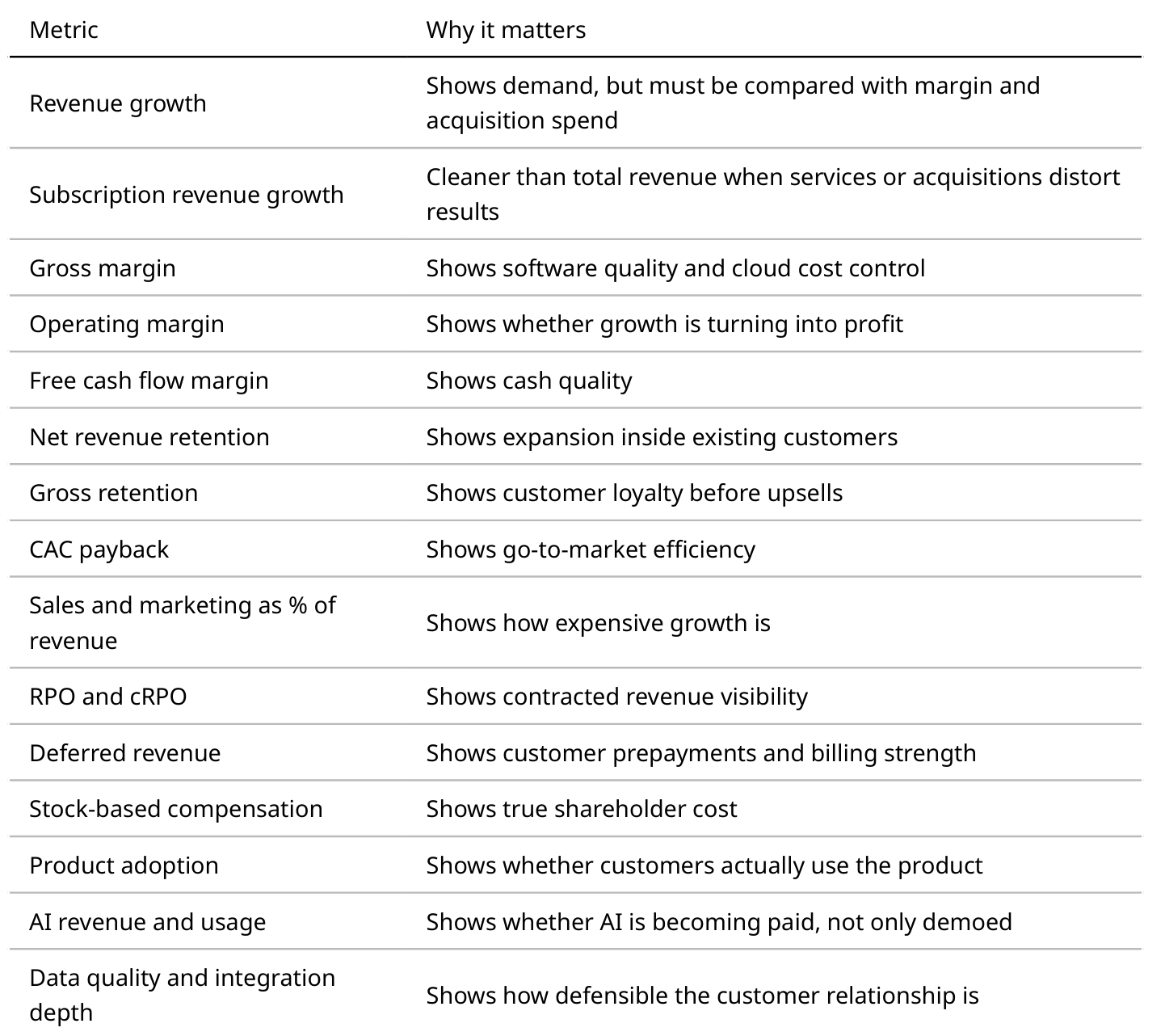
Investors should avoid judging CRM companies only by revenue growth.
The better checklist is:
Want to run this type of research on your own watchlist?
Use BE Invested Labs to generate structured company breakdowns, valuation notes, bull and bear cases, industry research, and AI audio briefings.
For Salesforce specifically, we would watch 5 items:
Organic subscription growth excluding acquisition contribution.
Agentforce ARR and actual production usage.
cRPO growth.
Free cash flow after buybacks and debt changes.
Customer willingness to pay for AI usage.
For HubSpot, we would watch upmarket progress and net retention.
For Microsoft, we would watch Dynamics adoption inside larger enterprise bundles.
For ServiceNow, we would watch workflow expansion into customer service and front-office processes.
For Adobe, we would watch whether marketing and experience products can defend budgets against AI-native tools.
For Oracle and SAP, we would watch CRM attachment to ERP and data platforms.
What makes a winner
A winning CRM and cloud software company needs more than a clean interface.
It needs durable customer value.
The best operators usually have 6 traits:
1. Strong retention
Retention proves the software matters.
If customers stay through budget pressure, pricing changes, and management turnover, the product is doing a real job.
2. Expansion revenue
The best CRM companies grow inside existing accounts.
One team starts using the product. Then another team joins. Then more modules get added. Then AI, analytics, data, workflow, or service products are attached.
3. Deep integrations
CRM becomes harder to replace when it connects to billing, support, marketing, ERP, data warehouses, identity systems, and communication tools.
Integration depth creates stickiness.
4. High data quality
AI makes this more important.
A CRM platform with clean account records, permissions, activity history, support data, product usage, and billing context has a better chance of producing useful AI output.
5. Efficient sales motion
Selling enterprise software can be expensive.
The best companies manage customer acquisition cost, partner channels, product-led adoption, and sales productivity carefully.
6. Trust
CRM vendors handle sensitive customer data.
Trust is not a soft factor. It affects procurement, regulation, renewal, and enterprise adoption.
Security breaches, AI mistakes, poor uptime, or weak governance can damage the thesis quickly.
The 5-year scenarios
Base case: platform consolidation and measured AI adoption
In the base case, CRM remains a core enterprise software category.
Large platforms keep winning major enterprise budgets. AI adoption grows, but customers demand proof before paying materially more. Seat growth slows in some areas, while usage-based AI revenue offsets part of the pressure.
Salesforce, Microsoft, ServiceNow, HubSpot, Adobe, Oracle, and SAP remain important.
The best returns come from companies that combine moderate growth, margin discipline, strong free cash flow, and credible AI monetisation.
Bull case: AI increases the value of customer data
In the bull case, CRM vendors successfully turn AI agents into paid production workloads.
Support agents handle more tickets. Sales agents reduce admin work. Marketing agents create and test campaigns. Customer success agents flag churn risk earlier. Managers get better forecasts.
Customers pay because the value is measurable.
This would favour vendors with clean data platforms, large installed bases, strong integrations, and trusted enterprise relationships.
Salesforce, Microsoft, and ServiceNow could benefit. HubSpot could also benefit if AI makes smaller teams more productive without heavy implementation.
Bear case: AI-native tools pressure the old model
In the bear case, buyers become more sceptical of traditional SaaS pricing.
AI-native tools handle narrow tasks faster and cheaper. Seat growth slows. Enterprise buyers push back against add-ons. Data remains messy. AI demos look good, but production results disappoint.
In that world, software vendors with weak product usage, poor customer satisfaction, and low net retention get punished.
The market would stop rewarding “AI attached to SaaS” and start asking for proof.
What BE Invested Labs is watching
The CRM debate is now about proof. Not press releases. Not demos. Not naming every product “AI”.
We are watching:
Agentforce, Copilot, HubSpot AI, ServiceNow AI, and Adobe AI production usage.
AI revenue separated from rebranded software revenue.
Net retention trends across CRM vendors.
cRPO and backlog quality.
Sales and marketing efficiency.
Free cash flow margin.
Cloud infrastructure cost as AI usage grows.
Customer support automation results.
Seat count pressure from AI.
Regulatory action around customer data and AI decision-making.
The most important question is whether AI increases what customers pay for CRM or reduces the need for traditional SaaS seats.
Both can happen at the same time.
That is why this industry is so interesting.
Our view
CRM and cloud-based software are still among the best business models in the market.
The economics are strong. The customer problem is real. The products sit close to revenue and retention. The best vendors have scale, switching costs, recurring revenue, pricing power, and large partner networks.
The industry is also more contested than it was 5 years ago.
AI brings new pricing models, new competitors, and new expectations from customers. It may make the best CRM platforms more useful. It may expose weaker platforms that were mostly selling seats, dashboards, and admin burden.
Our view is balanced. We like the structure of the industry. We are careful with valuation.
For investors, the cleanest approach is to separate business quality from price.
Salesforce can be a strong business and still be a difficult stock if expectations are wrong. HubSpot can be a great product and still be expensive. Microsoft can be the strongest strategic competitor even if Dynamics is only one part of the story. ServiceNow can benefit from workflow automation without being a pure CRM name.
The winners will show 4 things clearly:
Customers stay.
Customers spend more.
AI usage becomes paid.
Free cash flow keeps improving.
That is the CRM thesis.
The customer record is still worth owning. The next question is who turns it into the most profitable workflow.
Use BE Invested Labs to generate structured industry research, company breakdowns, bull and bear cases, valuation notes, and AI audio briefings.
Subscribe to BE Invested Labs for more industry breakdowns like this.
— Buyce & Emmanuel
BE Invested Labs
References and data notes
Sources used for this breakdown include BE Invested Labs CRM industry reports on business models, core economics, value chain mapping, unit economics, regulation, TAM, future growth scenarios, and macro outlook. We also reviewed recent Salesforce earnings coverage, CRM market commentary, public SaaS benchmarks, and AI-agent research including CRMArena.
Disclaimers & Disclosures
AI Transparency
BE Invested Labs uses AI to aggregate financial data and format reports. The AI structures the information. Users determine their own investment thesis, risk management, and market outlook. We audit the system outputs to reduce AI errors. We use these exact reports to manage our own capital.
Legal Disclaimer
This platform provides educational and informational content. BE Invested Labs is not a registered investment advisor and does not provide financial, investment, tax, or legal advice.