



The Idea That Changed Everything

My father, like most men of his generation, spent his leisure time reading physical newspapers. One afternoon in the early 2000s in Ghana, he called me over and told me about a man he had just read about. A man whose money worked for him even while he slept.
That man was Warren Buffett.
My father had been reading about Buffett’s investment in The Coca-Cola Company. To him, the story was astonishing. The idea that someone could own part of a business and continue earning from it for decades felt almost unreal.
For context, this was Ghana, West Africa, at a time when investing culture looked nothing like what people experience today through apps, brokerages, and financial content online. Back then, ownership in my environment was almost entirely associated with land. Families bought plots to preserve wealth, secure inheritance, and protect themselves from future uncertainty. Land was tangible. You could walk on it, fence it, build on it, and pass it to your children.
But land ownership also carried fear.
I grew up hearing brutal stories about land disputes and litigation. Families fought over boundaries, inheritance claims, and ownership rights. Some people lost their savings. Others lost relationships. In extreme cases, people lost their lives over contested property.
So when my father described a world where ownership could exist through businesses rather than physical land, something shifted in me. For the first time, I understood that wealth was not built only through labor. It could also be built through ownership.
That idea never left me.
The Problem: A System Built to Overwhelm You
At the time, I was a teenager with no access to stock markets, no investing mentors, and no roadmap. Most people around me were understandably focused on surviving immediate economic realities first. Investing in global businesses was not a common conversation.
Yet the fascination stayed. When my mother moved with my younger brother and me to Belgium, I carried it with me. At nineteen, I wrote in my diary that one day I wanted to own businesses, invest in companies, and build enterprises. It sounds ambitious, perhaps even naive. But I could not let it go.
Ironically, despite that fascination, I never pursued finance academically. Engineering called me instead. Mathematics, physics, systems, and computation stimulated my mind in a way few things could. Engineering taught me to think structurally: inputs and outputs, constraints and optimization, feedback loops and stability, failure modes and resilience.
Years later, I realized investing was not entirely different. A company is also a system. Management allocates resources the way engineers allocate energy or computational capacity. Poor leadership introduces instability. Strong organizational architecture creates resilience and long-term compounding.
Once I started working and earning a salary, I finally began acting on the ideas that had lived in my mind for years. And I made mistakes costly ones.
I bought stocks without understanding the underlying business or management incentives. I invested emotionally, buying when markets were euphoric and panicking when volatility arrived. I bought a home before building proper financial reserves. Like many beginners, I confused activity with strategy.
The Agitation: The Modern Investor Is Being Set Up to Fail
My early mistakes were honest ones. But here is what I eventually realized: the system itself is working against retail investors.
Today’s investing environment is noisier, more distracting, and more psychologically manipulative than at any point in history. Meme stocks. Day trading apps engineered around dopamine. Gamified interfaces that nudge users toward impulsive trades. Financial Twitter full of conflicting opinions. Reddit threads masquerading as research.
On one side, there are the institutional tools Bloomberg, Capital IQ , yahoo finance overwhelmingly complex, text-heavy, and priced at thousands of dollars per year. They were never built for ordinary investors.
On the other side, there is the noise clickbait headlines, speculative hype, and the relentless pressure of FOMO. That fear of missing out that pushes people into positions they do not understand, at prices they cannot justify, for reasons they cannot articulate.
The result? A generation of investors who genuinely want to build long-term wealth but find themselves paralyzed between complexity and chaos. I know this feeling intimately. I remember having twenty browser tabs open simultaneously, cross-referencing SEC filings, analyst notes, earnings transcripts, and macroeconomic reports and still feeling uncertain.
That is not research this causes exhaustion.
Disciplined, long-term investing understanding competitive moats, risk management, valuation discipline, and compounding requires exactly the kind of deep, structured thinking that the modern information environment actively punishes. Patience is boring. Rigor is slow. And in a world optimized for speed and stimulation, boring and slow rarely win attention.
The Solution: BE Invested Labs
Out of those circumstances the frustration, the tab overload, the noise my co-founder and I built BE Invested Labs.
The premise is straightforward: investing should be deeply rigorous and intuitively accessible at the same time. It should remove the cognitive biases, the FOMO, and the exhausting burden of fragmented research and replace them with clarity, confidence, and conviction.
Here is what that looks like in practice.
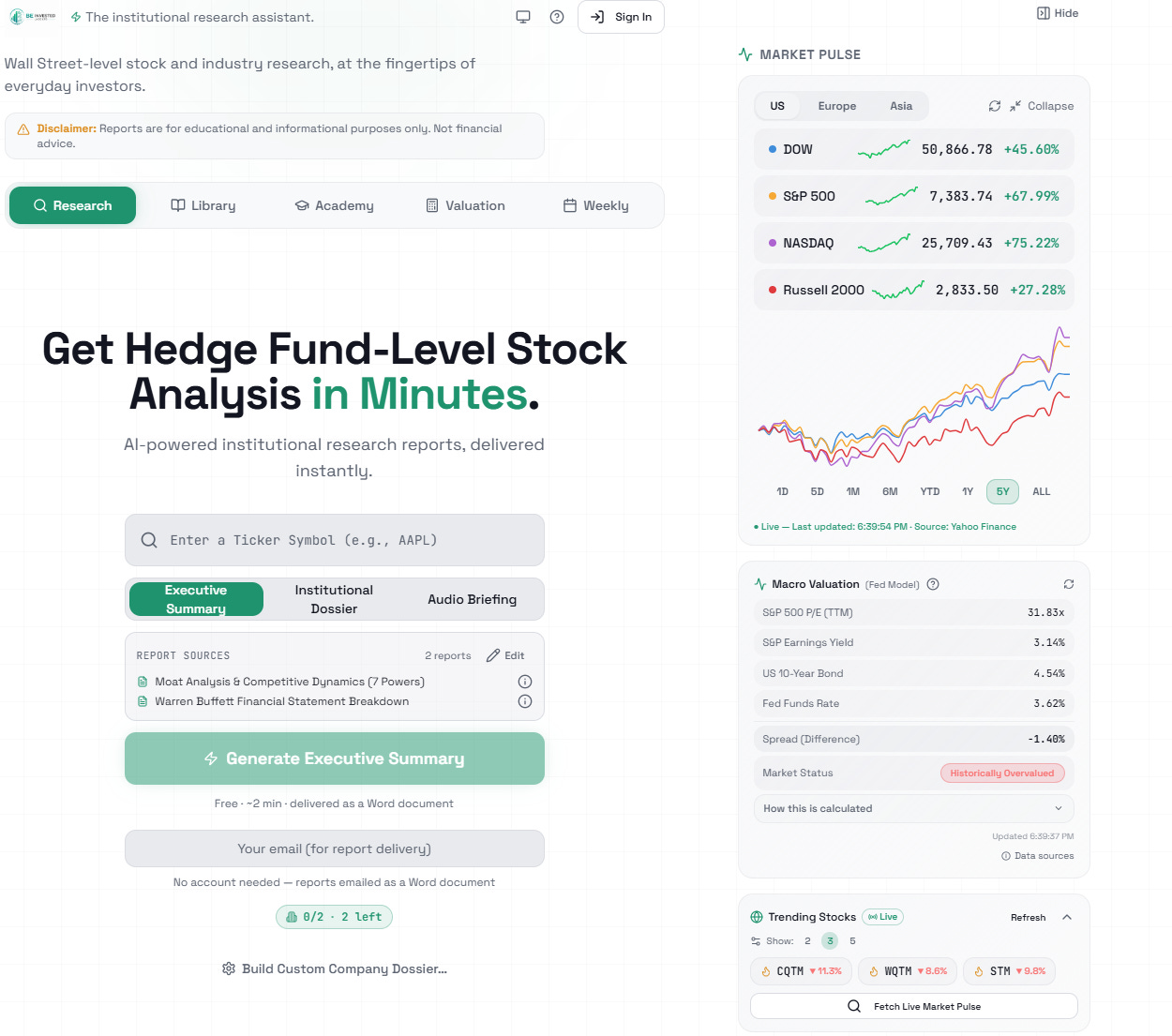
BE Invested Labs gives you instant access to 18 specialized AI analysts Forensic Accounting, Economic Moat Analysis, Valuation Discipline, and more operating 24/7 on any stock you want to research. Rather than raw data dumps or conflicting opinions, you receive structured, institutional-grade output in seconds:
Scorecards that grade each opportunity on a rigorous 9-point scale, mathematically flagging value traps before you put a single euro at risk. The system acts as an automated Red Team desk cross-referencing eight fundamental parameters to separate high-conviction setups from dangerous speculation.
Audio-first research podcasts featuring two AI analysts one Bull, one Bear debating the merits of up to five stocks simultaneously, designed to fit into your morning commute rather than demand another evening at your desk.
Institutional-grade synthesis reports that translate millions of data points into decisions you can actually act on — without the 150-page filings.
A free integrated Academy that grows alongside your portfolio, so the platform is not just a utility but a curriculum. The more you use it, the more your investing knowledge compounds alongside your capital.
You can explore the platform at beinvestedlabs.com.
What Ownership Really Means
Looking back now, I realise that newspaper article my father shared with me did far more than introduce me to investing. It changed how I saw ownership. And I believe ownership changes how people see the world.
Ownership changes your relationship with time it teaches patience over consumption. It changes your relationship with work you stop thinking only about income and begin thinking about the systems and competitive advantages that produce value beyond your direct labor. It changes your relationship with society you begin observing how businesses function, how incentives shape behaviour, and how capital flows through economies.
Most importantly, ownership expands imagination.
For a young boy growing up in Ghana, the realisation that he could someday participate in the global economic system not merely as a worker, but as an owner was transformative. That dream still lives in me today.
And perhaps that is the real reason my co-founder and I built BE Invested Labs. Because somewhere between my upbringing, engineering career, and investing in global markets, I discovered a simple but life-changing idea:
Wealth is not only earned. It can also be designed, owned, and compounded.
We built the platform to make sure that idea is no longer reserved for the few.
Try BE Invested Labs at:
Disclaimers & Disclosures
Transparency on AI utilisation: We utilises advanced artificial intelligence and synthetic strictly as data-aggregation and formatting force multipliers. AI does not dictate our thesis or that of the users of BE Invested platforms, manage our risk, or formulate our macroeconomic outlook. Every piece of intelligence is rigorously audited, curated, and synthesised by our founder to minimise hallucinations. We have skin in the game; this is the exact intelligence we use to position our own capital.
This is Educational and informational purposes only. Not financial, investment, tax, or legal advice. BE Invested Labs is not a registered investment advisor.
Wish I had a backstory that is equivalent to a superhero. That’s amazing how you got where you are.
I saw you’d popped me a DM, but in the UK you need ID to read DMs so I never bothered setting it up, would you mind either copying it and replying to this comment or emailing me @ josh.invest.business@gmail.com